Charles Babbage Quotes
Errors using inadequate data are much like those using no data at all.
Charles Babbage, 1792-1871, English Mathematician and Inventor, Political Economist, Frequent Statement
Sourced by: Eigen's Political and Historical Quotations


This principle is very important in all kinds of human activity. We design and test or pilot test products and programs of all kinds—governmental and not. The testing may uncover a flaw or problem, but the failure to find flaws or problems does NOT mean that they are not inherent in the program—they may well be there and have not been uncovered by the tests. Often when this occurs, we refer to them as “unintended consequences.”
The Labor Department never would commit to a recommendation. The Job Corps leadership examined the insufficient data and made their best guess which for the most part turned out to be right as the Job Corps was the most effective youth job training program in the history of the country. It and Head Start were the only two of the anti-poverty programs that were still operational into the 21st century. Supreme Court Justice Learned Hand expressed the same idea more generally in {482001}.


This was one of the critical quotes from the handling of the Great Depression. The President had a series of radio talks to the people in which he addressed them directly and explained things as he then understood them. In this particular quotation he was trying to manage the public’s expectation and told them quite candidly that he and his administration would make some mistakes—some Presidents like Hoover, his predecessor, rarely ever admitted error.


See {234968} for an earlier, similar view.


We all have 20-20 hindsight, and sometimes well analyzed decisions turn out badly as the result of unfortunate circumstances.
This quotation shows FDR doing something that politicians rarely do. The country was in the midst of the Great Depression and he was running for the Presidency against Herbert Hoover who as President would do little to help the destitute part of the population or improve the economy. Roosevelt did not lay out specific programs which he claimed would fix the problem. He himself really didn’t know for certain what would and what would not. However he promised bold experimentation—trying new things. When he was elected, he was able to fail with one program and just shift to another until enough were successful. But the great contrast was to Hoover who would do little.
Two of the 20th centuries greatest political leaders were Mao Tse-Tung and Franklin Delano Roosevelt. In most respects, these two were polar opposites. However, they had one characteristic in common. They were both willing to try things they were not certain of. If they succeeded, make it a part of the national program. If it failed, try something else. See Mao {642795}.


Prior to this policy change, the Port Authority made and started to implement decisions and THEN held public hearings. The Port Authority is a bi-state organization that is the largest building authority in the country. It has built and operated all the bridges and tunnels connecting New York City Boroughs and the City with New Jersey and Long Island. They also have built and operated many of the major highways and recreation centers in New York City and Long Island. Additionally, it erects large buildings and other facilities like the World Trade Center. It’s funding comes directly from tolls, rents and other income from its facilities and the bonds that it floats, and so does not need any funding from either state. It actually makes a huge profit. It was started by Robert Moses, who wanted Independence of operation from the States of New Jersey and New York and the New York City Government. Moses was known for his authoritarian, non-consultative style, and subsequent Chairman tried to maintain that. Moses and the Port Authority had stayed clear of political influence and corruption. However, gradually the appointees were more and more beholden to the Governors of the two states and in 2014 a major scandal erupted where the New Jersey Governor’s staff was using the Port Authority to punish communities what did not support the Republican Governor Christie. This triggered calls for reform of which this new policy was one of the first.

Two of the 20th centuries greatest political leaders were Mao Tse-Tung and Franklin Delano Roosevelt. In most respects, these two were polar opposites. However, they had one characteristic in common. They were both willing to try things they were not certain of. If they succeeded, make it a part of the national program. If it failed, try something else. See FDR 52,743.

While the context applied to making business policy decisions, he also advocated it for politics and managing government. If policy makers or managers speculate and then act to fix possible and imaginable problem, they will waste time and resources dealing with eventualities that may never come to pass. A better strategy is to obtain data, analysize that, and fix the problems that we know will occur.

3rd Earl Russell of Kingston

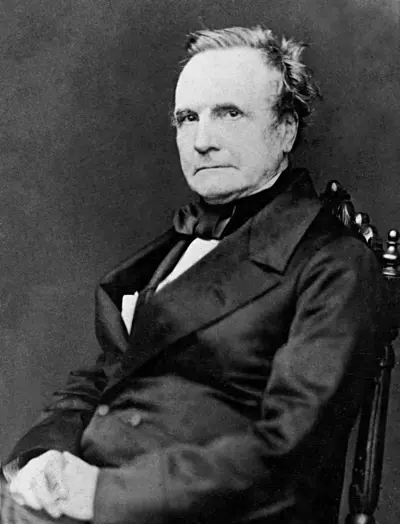
Charles Babbage KH FRS was an English polymath. A mathematician, philosopher, inventor and mechanical engineer, Babbage originated the concept of a digital programmable computer.
