Gilbert K. Chesterton Quotes
England and Ireland are so united that the Irish can sometimes rule England, but can never rule Ireland.
Although the Irish members of Parliament were never sufficient to control Parliament on an “Irish question” pitting Irish against English, they were at times in sufficient numbers to hold the balance of power between English factions, thus “controlling England.”
Gilbert K. Chesterton, 1874-1936, English Writer, Heretics
Sourced by: Eigen's Political and Historical Quotations


Browne, an Englishman by birth, was the instrument of the Protestant Reformation in Ireland.

Given the time, Mill’s view on the colonies were appreciated by few Englishmen, but turned out to be exactly predict the British reality a century later.

The violent IRA logic had always been a little tortured. At the time, the claim was that the British were not wanted in Ireland but were there only by force of arms. However, the British administration of Ireland at the time was not forceful or violent at all. Few others had the freedom and democracy of Ireland as a part of Great Britain. De Valera’s logic was that if the British in Ireland were subjected to violent, terrorist attacks, they would respond with force of arms, and thus show that they held Ireland by force. Most of the Catholics of Ireland preferred independence while most of the Protestants preferred the relationship with England.

He had been exiled to the United States.

The Catholic majority was politically dominated by the Protestant minority in Ireland and the English Parliament generally sided with and supported the Protestants. O’Connell was open to Ireland being a part of the British Empire if it was the majority Catholic Ireland that was a part of the Empire.

The Chief Secretary, Lord Castleregh, had put forward a resolution to bring about the unification of Great Britain and Ireland under the single British Parliament at Westminster. He and his allies had bribed a number of the Irish MPs to support the union. With Union some Irish MPs would then be able to win seats representing Ireland in the British Parliament. Although Grattan and most of the Orangemen opposed the Union, 4 months later, the bill passed comfortably. Ironically, Grattan was one of the Irish MPs whose popularity won a seat in the unified British Parliament.

He was addressing the Conservatives of Ulster, the Northern Ireland province that was the center of the Orangemen movement of Irish Protestants who were fighting to retain 'Protestant Ascendency' -- which was the social, political and cultural domination of the Protestants (the minority) over the Catholics (the majority). This was best achieved by keeping Ireland a part of Great Britain as opposed to having Ireland as a separate, independent country.


After the King’s appointment in 1921 she “advised” him on establishing this regime and operating the government. At a time that women could not even vote in England, Bell was a kingmaker and major power in an area of the world that was much more sexist than England at the time.


Even in modern times many politicians the world over agree with Davis’s point that for a government to function well, the nation must have a homogenous citizenship. This is especially true of dictatorships where control of a uniform culture and populous is easier than if it is diverse nation. In modern times, the three greatest economic and scientific powers, the United States, The Soviet Union, and China were and are multicultural societies with different ethnicities, races, religions, and cultures among their sitizenry.


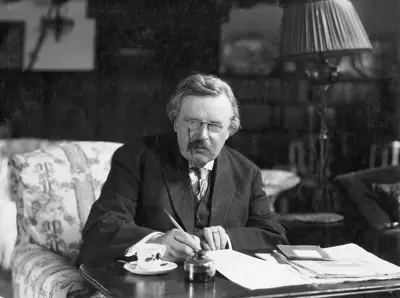
Gilbert Keith Chesterton KC*SG was an English writer, philosopher, lay theologian, and literary and art critic. He has been referred to as the "prince of paradox". Time magazine observed of his writing style: "Whenever possible Chesterton made his points with popular sayings, proverbs, allegories—first carefully turning them inside out."
