William McKinley Quotes
Economy is demanded in every branch of the government at all times, but especially in periods like the present, of depression in business and distress among the people. The severest economy must be observed in all public expenditures, and extravagance stopped wherever it is found, and prevented wherever in the future it may be developed. If the revenues are to remain as now, the only relief that can come must be from decreased expenditures. But the present must not become the permanent condition of the government.
The country was in a terrible recession and McKinley and other politicians of the time did not know about or understand the use of a counter-cyclical policy of government stimulus. With the economy devastated and the main revenue for the Federal Government coming only from import customs duty, the Federal coffers were emptying rapidly. Retrenchment was the only possible step that was then known.
William McKinley, 1843-1901, 25th President of the United States (Republican, OH), Speech, Canton, Ohio, March 1, 1897
Sourced by: Eigen's Political and Historical Quotations

The Dutch King’s brother, Emperor Napoleon Bonaparte Bonaparte, insisted on Dutch contributions to his war effort in the way of Dutch troops, ships and provisions. Yet there was not enough possible revenue to pay for such a war effort.

Bloomberg was one of the few people who say the meltdown of 2008 coming. His principle of saving a surplus for spending in the downturns, which served New York so well goes against most Democrat and Republican politicians. If there is a surplus, the Democrats want to spend it. The Republicans want to cut taxes and return the surplus. Neither is prepared for an economic slowdown.


1st Viscount Snowden

The Dutch King’s brother, Emperor Napoleon Bonaparte Bonaparte, insisted on Dutch contributions to his war effort in the way of Dutch troops, ships and provisions. Yet there was not enough possible revenue to pay for such a war effort. Gogel was able to introduce efficiencies in many areas but still more taxes were needed. War expenditures took all the resources of the state and progress stopped and the kingdom was almost destroyed by the economic crisis.


Perry was one of a number of politicians who became opposed to deficit spending, and claimed that the public was not interested in the various projects. However, whenever any of these politicians proposed projects or programs to cut, there would be many citizens who would object vehemently. It was precicely because there was a constituency supporting all the government programs that politicians found it so hard to keep spending under control. Indeed, when others suggested terminating spending on programs and projects Perry liked, he objected as strenuously as most others.


Both the House and the Senate, as they got larger, developed an Appropriations Committee. When the committee assessed a departmental appropriation, they had also the responsibility for all the other departmental budgets. However, many of the members of the Appropriations Committee tended to favor the interests of their particular constituency or the special interests to which they were beholden. Other members had little or no influence. So there was immense pressure during Reconstruction to ‘share’ the appropriations ‘plum’ by creating appropriations subcommittees. However, each particular subcommittee loses the perspective of and interest in the budget as a whole. The process has led to budget imbalance pressure ever since. But Randall, the Speaker of the House warned about exactly what would happen. He had earlier served as Chairman of the Appropriations Committee, and he was exactly right.

This is a particularly interesting historical quotation. It shows that when FDR was first elected, he had a classic view of deficit spending. However, above all, Roosevelt was a pragmatist and not an ideologue. Faced with the Great Depression that was not getting much better, Roosevelt turned around, changed his mind and policy about deficits and embarked on the “pump priming” approach of injecting substantial Federal spending into the economy and accepting the deficits in order to improve the situation which had been stagnant. FDR’s new policy staved off total disaster, but few remember that his great success was a total reversal of his earlier views.

Although the Professor was often right about this technique, at the time he made this statement, the Clinton administration was actually cutting spending and using much of the revenue to pay for the deficit—just the opposite of what the Professor was worried about. It was successful and the deficit was eliminated and surpluses were projected. However the succeeding administration more closely followed the professor’s pattern and increased spending enormously for serious needs, but also cut taxes, so that we went during the Bush administration from the largest projected surplus in American history to the greatest deficit in American history.

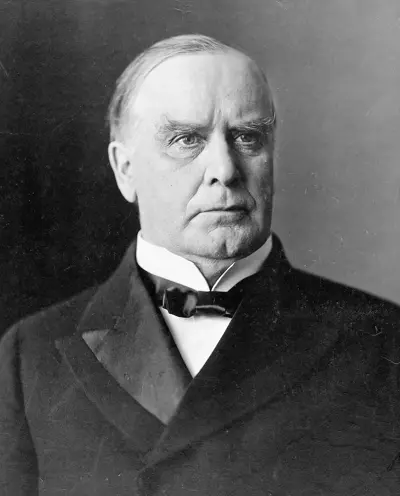
William McKinley was the 25th president of the United States, serving from 1897 until his assassination in 1901. McKinley was president during the Spanish–American War of 1898, raised protective tariffs to boost American industry, and rejected the expansionary monetary policy of free silver, keeping the nation on the gold standard.
