Clarence A. Cannon Quotes
Any government, like individuals and families, cannot spend more than they take in without courting disaster.
Clarence A. Cannon, 1879-1964, U. S. Congressman (Democrat, MO), House debate, September 26, 1961
Sourced by: Eigen's Political and Historical Quotations


By the time the debt ceiling needs a Congressional vote, the money has already been obligated and spent. That is when Congress can control spending. The debt ceiling is ALWAYS increased by Congress when asked otherwise the U. S. would not be able to pay its bills. However, many members of Congress like the fact that every year or so the administration needs their votes so they can extract benefits for their constituents more easily with that leverage.


Perry was one of a number of politicians who became opposed to deficit spending, and claimed that the public was not interested in the various projects. However, whenever any of these politicians proposed projects or programs to cut, there would be many citizens who would object vehemently. It was precicely because there was a constituency supporting all the government programs that politicians found it so hard to keep spending under control. Indeed, when others suggested terminating spending on programs and projects Perry liked, he objected as strenuously as most others.


This is a particularly interesting historical quotation. It shows that when FDR was first elected, he had a classic view of deficit spending. However, above all, Roosevelt was a pragmatist and not an ideologue. Faced with the Great Depression that was not getting much better, Roosevelt turned around, changed his mind and policy about deficits and embarked on the “pump priming” approach of injecting substantial Federal spending into the economy and accepting the deficits in order to improve the situation which had been stagnant. FDR’s new policy staved off total disaster, but few remember that his great success was a total reversal of his earlier views.
_0_thumbnail_47x47.jpg "Bill White, Mayor of Houston, Texas")


The Dutch King’s brother, Emperor Napoleon Bonaparte Bonaparte, insisted on Dutch contributions to his war effort in the way of Dutch troops, ships and provisions. Yet there was not enough possible revenue to pay for such a war effort.

The country was in a terrible recession and McKinley and other politicians of the time did not know about or understand the use of a counter-cyclical policy of government stimulus. With the economy devastated and the main revenue for the Federal Government coming only from import customs duty, the Federal coffers were emptying rapidly. Retrenchment was the only possible step that was then known.

The Dutch King’s brother, Emperor Napoleon Bonaparte Bonaparte, insisted on Dutch contributions to his war effort in the way of Dutch troops, ships and provisions. Yet there was not enough possible revenue to pay for such a war effort. Gogel was able to introduce efficiencies in many areas but still more taxes were needed. War expenditures took all the resources of the state and progress stopped and the kingdom was almost destroyed by the economic crisis.

The United States has an unusual set of laws with respect to paying the nation’s bills. Congress must vote for the budget which authorizes and triggers the buying and spending. Then when it comes to paying for what has been bought, Congress must vote again to raise the debt ceiling so the national can pay for what Congress has already directed to be bought. Congress, in 2012 and 2013, voted to spend the money and then balked at authorizing the administration to borrow the money to pay the bills.
At the time, the Republicans cast themselves as the party of prudent and responsible budgeting and the Democrats as the party of spending, especially on social services. The reality was just the reverse for a period of time, when it was the Clinton Democratic Administration that had a balanced budget and a surplus as opposed to the Republican administrations of high deficits and even greater social spending than the Democrats. Greenspan was himself a Republican which added a little sting to the quotation.

Although the Professor was often right about this technique, at the time he made this statement, the Clinton administration was actually cutting spending and using much of the revenue to pay for the deficit—just the opposite of what the Professor was worried about. It was successful and the deficit was eliminated and surpluses were projected. However the succeeding administration more closely followed the professor’s pattern and increased spending enormously for serious needs, but also cut taxes, so that we went during the Bush administration from the largest projected surplus in American history to the greatest deficit in American history.


This is the kind of advice that Presidents have given the Congress for years. What makes this quotation noteworthy is the person who made the statement, President George W. Bush. It was made in the 7th year of his Presidency which had in those 7 years, at his urging, gone from a balanced budget and a national surplus projected, to the largest deficit of any nation in history and a projected deficit that even dwarfed that. So the irony of the quotation was that the politician who produced the largest economic burden on future generations was lecturing other politicians on the evils of doing exactly what he himself had been doing. Bush, if nothing else, was one of the most audacious politicians in this respect, though his most severe detractors claim that he did not have the intellectual perspective to even understand the hypocrisy of his quotation,


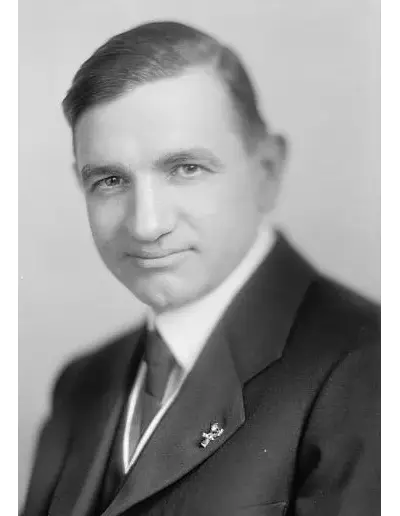
Clarence Andrew Cannon was a Democratic Congressman from Missouri serving from 1923 until his death in Washington, D.C. in 1964. He was a notable parliamentarian and chaired the U.S. House Committee on Appropriations. He is the longest-serving member of the United States House of Representatives from the state of Missouri.
