Louis D. Brandeis Quotes
Don't assume that the interests of employer and employee are necessarily hostile—that what is good for one is necessarily bad for the other. The opposite is more apt to be the case. While they have different interests, they are likely to prosper or suffer together.
Louis D. Brandeis, 1856-1941, U. S. Supreme Court Justice, Quoted in Mason, Brandeis: A Free Man's Life, Viking, 1946
Sourced by: Eigen's Political and Historical Quotations

Management and labor were extremely estranged at that time and each wanted more for themselves without regard for each other or the economy and people as a whole. The inflationary pressure was great. There were calls for Government to step in and institute wage and price controls. To Beveridge, that was to be avoided.


She saw strikes as wasteful where the workers and the companies, the public and the government lost. She favored arbitration which was generally opposed by labor and management and still is today in most cases.


This is a fascinating historical quotation about labor disputes and strikes. The conservatives at the beginning of the 20th century were horrified at the idea of a strike of any kind. Their idea of a labor dispute with picketing would allow one or two protesters with signs stating their case to stand outside the factory. Or one person visiting a worker and suggesting that the worker not work during the strike. However, when the degree of passion was expressed by many people picketing they were opposed. At the time, the working class and the unions had no other resources other than the bodies of their workers. They could not advertise, publish newspapers, hire lobbyists to explain their point of view to Parliament. The conservatives then were then very undemocratic and believed that the monarchy with a responsible aristocracy of the upper class should run the nation for all. They WERE actually intimidated by a large number of people doing anything that was not endorsed by or approved by the ruling class. Women in large protest marches for the right to vote were intimidating also. The threat was, as they saw it, “Do as we demand or we will bring down the world as you know it.” In a sense that is what happened. There is no conservative in England who would today deny a union the right to picket with many people.


After a CIO retail clerks’ union led a strike against Montgomery Ward, Bridges’ union declared that their union and other unions should oppose any labor strikes during World War II.
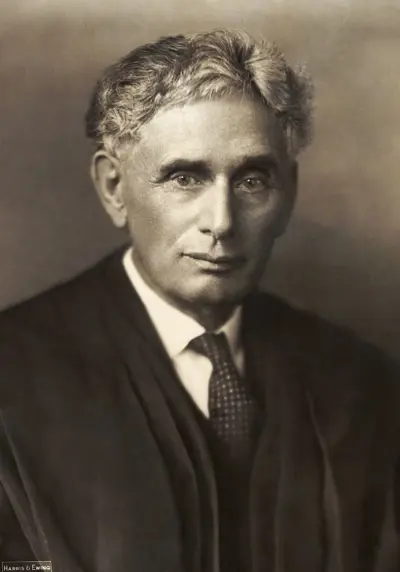
Louis Dembitz Brandeis was an American lawyer and associate justice on the Supreme Court of the United States from 1916 to 1939. He was born in Louisville, Kentucky, to Jewish immigrant parents from Bohemia (now in the Czech Republic), who raised him in a secular home. He attended Harvard Law School, graduating at the age of 20 with the highest grade point average in the law school's history. Brandeis settled in Boston, where he founded a law firm (that is still in practice today as Nutter McClennen & Fish) and became a recognized lawyer through his work on progressive social causes.
