Book of Mormon Quotes
Deseret—Mormon name for Utah And they did also carry with them Deseret, which, by interpretation, is a honeybee; and thus they did carry with them swarms of bees, and all manner of that which was upon the face of the land, seeds of every kind.
Referring to the prophet Jared and his family in search of the Promised Land.
Book of Mormon, Esther 2:3
Sourced by: Eigen's Political and Historical Quotations


The use of “despotic” did not imply cruelty or even poor management of the society. The term was used to indicate that Brigham Young, the then Mormon Leader, had the powers and authority of a dictator. At the time most Americans in the East knew little about the Mormons. Ludlow was one of the early observers of Mormon society in Utah who wrote about the Mormons in popular—albeit intellectual—magazines. Ludlow regarded Mormonism as it was then practiced as incompatible with, and dangerous for, America, not because of the plural marriage, but the conflicts with the concepts of democracy and self-government. The authority that Brigham Young and the church then exercised over civil life was what distressed him and many other Americans.

We count on Mormon assemblages to

The Mormons wanted Utah to be a United States territory or a state with an extreme state’s rights mentality whereby their religious doctrine in the Book of Mormon could be state law and at the time the Constitution had not yet been amended to require the state governments to adhere to the Bill of Rights or other Federal laws. In effect they wanted a democratic type of theocracy. See {619869}. The Mormons would not agree that Federal law should govern their community or people, and war with the Federal government was imminent. In an ironic twist, Johnson, a Texan, rebelled against the nation himself several years later when he became a Confederate General. He was the highest ranking Confederate Officer killed in Battle—at Shiloh.


The Mormon emigrants to Salt Lake City were vulnerable to hoarding. This ordinance was one of many laws and structures that the early Mormons established that had the community legally above the individual. To many, these cooperative attempts and laws to prevent disproportionate asset accumulation were signs of socialism.


Five years earlier, Young had all but given up on the idea of converting Native Americans—see {619863} and {619863}. Young was very ambivalent about the Indians, at some points wanting to convert them and on others to have them removed from the area to make way for Mormon growth and development--{619865}. At this time, the Mormons and the Federal Government were at loggerheads regarding the requirement for enforcing Federal law in all territories including Utah. Young and others hoped to enlist Indian warriors in any potential battles with the army.
The Mormon settlement of the West has, from an economic development point of view, produced a successful model that few have ever even approached. Using techniques that ranged from classic capitalism to classic socialism, they blended both systems into a unique structure of their own. The results were spectacular despite the fact that the Mormons faced boycotts from manufacturers throughout the country and could borrow no money from banks, and never received any financial help from the Federal or any other government but their own. Even if they had gone into heavy debt, the results would have been spectacular, but achieving all that without any debt whatsoever is one of the most successful economic developments in the history of the world.
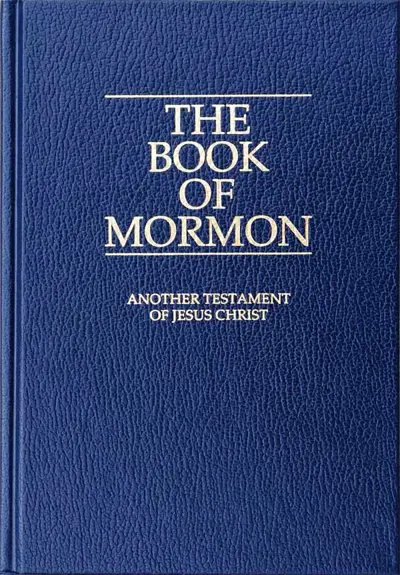
The Book of Mormon is a sacred text of the Latter Day Saint movement, which, according to Latter Day Saint theology, contains writings of ancient prophets who lived on the American continent from approximately 2200 BC to AD 421. It was first published in March 1830 by Joseph Smith as The Book of Mormon: An Account Written by the Hand of Mormon upon Plates Taken from the Plates of Nephi. The Book of Mormon is one of the earliest of the unique writings of the Latter Day Saint movement, the denominations of which typically regard the text primarily as scripture, and secondarily as a historical record of God's dealings with the ancient inhabitants of the Americas. Mainstream archaeological, historical and scientific communities do not consider the Book of Mormon to be an ancient record of actual historical events.
