Atal Bihari Vajpayee Quotes
Declaring victory without war .. the belief that India gave up the option of war under American pressure is totally wrong.
Vajpayee, Atal Bihari. "Statement in the Lok Sabha on the Standoff with Pakistan." Four Decades in Parliament, edited by N. M. Ghatate, Shipra Publications, 2003, p. 115.


After the attack on Fort Sumter, the South Sent “diplomats” to negotiation with the Government. Unfortunately for all, the South really was not open to negotiations as they only had two predetermined positions they would agree to: The first was that the Government should guarantee the perpetual right of states to have slavery if they wished and that fugitive slaves would be returned by the non-slave states. The second was that the Union should recognize the Confederacy as an independent nation and have peaceful relations between the two. The first was impossible to deliver even if the Union would agree to continue slavery, there was no way that the Federal Government could enforce the return of fugitive slaves from many northern states where they were free the second they set foot in the state, and the Northern states demanded States Rights and not being forced to return Fugitive Slaves forcing the Southern States to oppose States Rights when it came to Fugitive Slaves while favoring it for slavery itself. The Federal government could not enforce the Dred Scott Decision under the pro-South Buchanan administration. And Lincoln and most of the Northern Politicians would not accept a complete dissolution of the Union. There are no other possibilities the South would accept and there was really nothing to negotiate.

The report was from Heinrich von Tschirschky, the German ambassador to Austria-Hungary. He recommended that Germany persuade Austria-Hungary to not attack Serbia, not realizing the German leaders had already planned a war with Russia and saw the issues between the Austro-Hungarian Empire and Serbia was a good excuse to implement their war plans (see {642092}).


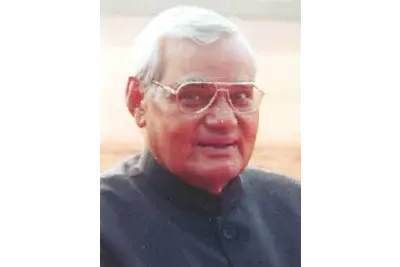
Atal Bihari Vajpayee was an Indian statesman who served three terms as the Prime Minister of India, first for a term of 13 days in 1996, then for a period of 13 months from 1998 to 1999, followed by a full term from 1999 to 2004. Vajpayee was one of the co-founders and a senior leader of the Bharatiya Janata Party (BJP). He was a member of the Rashtriya Swayamsevak Sangh, a Hindu nationalist volunteer organisation. He was the first Indian prime minister not of the Indian National Congress to serve a full term in office. He was also noted as a poet and a writer.
