John Lewis Quotes
Black men and women were not allowed to register to vote. My own mother, my own father, my grandfather and my uncles and aunts could not register to vote because each time they attempted to register to vote, they were told they could not pass the literacy test.
Lewis, John. "Testimony Before the House Judiciary Committee on the Voting Rights Act." U.S. House of Representatives, 2006.

Preclearance was a requirement that any change in the voting or registration laws, rules or procedures needed to be approved by the Federal Justice Department. He was testifying about why preclearance was important and why it was placed in the Voting Rights Act every time it was reauthorized. See {635271} for what happens without preclearance.


In the South racism was so extensive that Blacks were not allowed to even vote. Brooke had moved from the South to Massachusetts and there as in the North, Midwest and West, African Americans could vote. So the first time Brooke ever voted he was a candidate.


At the time Negroes were prohibited from voting by a series of discriminatory criteria for voter registration and intimidation so that Blacks would not generally even try to register. But the Civil Rights movement changed tactics and organized large scale attempts at voter registration. Mayor Thompson and the white power structure of the town were not going to allow that. They had not only enlarged the police department but the city purchased an a small armed tank.


The President was asking for passage of his Voting Rights Bill.


Vardaman, on of America’s worst racists, was one of the main drafters of that constitution. This is an example of why the Voting Rights Act was later needed to unravel a endemic system of keeping African Americans from voting or having any part in politics.
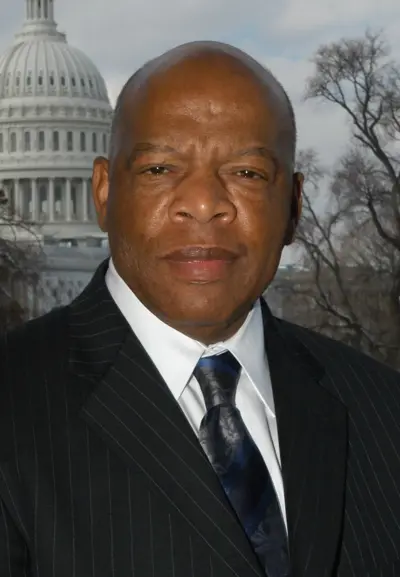
John Robert Lewis was an American politician, statesman, and civil rights activist and leader who served in the United States House of Representatives for Georgia's 5th congressional district from 1987 until his death in 2020. He was the chairman of the Student Nonviolent Coordinating Committee (SNCC) from 1963 to 1966.
