Serzh Sargsyan Quotes
Azerbaijan unleashed the war [against Armenia], and was defeated in that war; Azerbaijan asked for truce, … and later started to sob about the dire repercussions of that war. As if wars ever bring pleasant repercussions. And on top of that, Azerbaijan adopted a conceited stance and started to make demands as if anywhere in the world defeated aggressors are ever allowed to make demands.
The war was an attempt of Muslim Azerbaijan to Islamize a Province of Armenia with both Muslim and Christian residents. While he was surprised that the aggressor, after losing the war then started, began making demands of the victor, this has been a historical, traditional tactic of many Islamic societies. The veiled threat is that if you do not adhere to our demands, we will start another war and another until we get our demands. This has occurred after every war against Israel that the Arabs started. They were always defeated, and they always made demands soon afterward. This technique has been used ever since the Ottoman Empire collapsed. It is one of the reasons that peace treaties with or between Islamic countries are hard to negotiate and implement because the country may have lost the immediate war, but they have not lost the will to fight. There are many military thinkers who believe wars are not won by killing and capturing soldiers and capturing territory, but only by breaking the enemy’s will to fight. Wars in the Middle East have had the pattern of whichever party is clearly losing sues for peace, and is supported by the international community in that goal. So the fighting and damage ceases before the loss can be so great that the loser loses the will to fight.
Serzh Sargsya, President of Armenia, Chairman, Republican Party of Armenia, Military Leader in the Nagorno-Karabakh War, Remarks, Press Conference, October 16, 2010
Sourced by: Eigen's Political and Historical Quotations

The so called War on Terror had many lessons. President Obama and many of the military leaders in the Pentagon realized that just as we evolved the concept of a Cold War, a new concept was needed to deal on the long run with the Al Qaeda terrorists. Typically in war, the nation is fully mobilized with the surrender of the enemy the major objective. When peace is negotiated, there is some demobilization and other things begin to take precedence. However, given the non state highly decentralized nature of Al Qaeda, there is no way to ever negotiate peace because no Al Qaeda official can speak for any more than his immediate cell and cadre. They will likely never stop attacking in any foreseeable future since their motivation is ideological and religious. It doesn’t take full military mobilization to protect against individual acts of terrorism, and indeed arguably the large mobilization only gives the terrorists more nearby targets. So American leaders were evolving a state of high protection, surgical strikes and attacks on Al Qaeda leadership and cells, and at the same time a demobilization of many of the overseas ground troops. It is not a state of war yet there will be attacks from time to time against us and attacks by us on Al Qaeda, yet there cannot be an all out war which is de factor non winnable in toto, but is very controllable. For Stein and other hawks, this new state is unfathomable. If there is any attack on Americans or American interests to them we are either at war with full mobilization or have surrendered. The total number of American civillians killed in the 10 year war on terror has been less than 2 months of normal automobile crash deaths or 3 months worth of gun accidents, or one tenth of the deaths caused by flu in a single year.


In this case, he was referring to the situation with the Barbary Pirates who had an incredible extortion racket going in the Mediterranean. If nations would pay them an annual sum each year, they would not attack and seize merchant ships of that country and sell the ships and goods while holding the sailors for ransom. Jefferson favored and authorized war—a naval attack which for many reasons the European nations had not done (they just paid the tribute). Then a peace treaty was finally signed—the first American Treaty.


The English were at War with Napoleon and Denmark was neutral. British leaders feared that Denmark might either ally themselves with Napoleon or provide him with ships from their well equipped fleet. The English decided on a preemptive attack on Denmark and Paget and other Captains were ordered to Denmark. When they arrived they were ordered to bombard Copenhagen and force the Danes to surrender. When this happened, the British seized the Danish ships and simply took them as war prizes. The issues of the morality and wisdom of preemptive attacks, as with the Americans in the Iraq war, was thoroughly debated but the government view prevailed to the shame of most Englishmen.

Right wing conservatives were not always in favor of large defense expenditures. Prior to WWII most were opposed to defense spending and they were the pacifists. Clark was one of the few that maintained this view after WWII.

The meaning is that to be victorious in war one should not be inhibited from doing cruel and brutal things that war sometimes necessitates.


At the time the President denied that he had decided to invade Iraq. Skelton saw the “handwriting on the world.”


He was the first of the modern Western poets and is often referred to as the Father of the Humanities


German ally, the Austro-Hungarian Empire had declared war on Serbia. See {642085}. The Russian Czar was under great pressure because a large Roman Catholic Empire was warring against a small Orthodox co-religionist of Russia and Russians of all classes wanted Russia to defend Serbia. The Czar was making a good faith effort to stave off the war. What he did not realize was that Germany had actually planned for war against Russia and France and was using the alliance with Austria as an excuse.


Kerry, a decorated, former Navy officer, was then a spokesperson for Vietnam Veterans Against the War.

Shortly after, he backed off the notion of having a bloodbath removing protesting students.
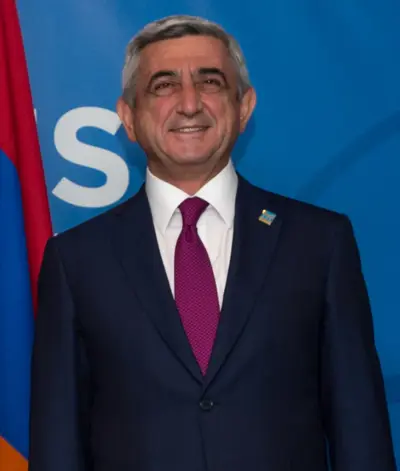
Serzh Azati Sargsyan is an Armenian politician who served twice as the Prime Minister of Armenia and was the third President of Armenia, from 2008 to 2018. He won the February 2008 presidential election with the backing of the ruling Republican Party of Armenia, a party in which he serves as chairman, and took office in April 2008. On 18 February 2013, he was re-elected as president and served the entire term.
