Victor Hugo Quotes
As for the bishop, the sight of the guillotine was a great shock to him, from which he recovered only slowly.
Hugo, Victor. Les Misérables. Translated by Charles E. Wilbour, Carleton, 1862.


Joseph-Ignace Guillotin was not thye inventor or the execution machine that bears his name. The actual inventor of the prototype was Antoine Louis. However, Guillotin--a physician by training was very concerned that a very high percentage of beheadings were botched by the executioner and the victim suffered greatly. He became the public and political advocate for the reform of the mode of execution in France to reduce suffering. The device ended up with his name as the noun to describe it. In this quotation, he made his first majhor speech to his fellows of the French Chamber of Deputies in 1791. Prior to the Frech Revolution beheading was the method of execution reserved for the Nobility & Aristocracy. They couod pay the executioner a "fee" to be sure that his sword or ax was sharp and that he/she would not suffer much. Nonetheless, many executions were botched. After the Revolution giving ALL citizens the same royal execution if they were convicted felons. So its adoption was a revolutionay act and philosophically based.


Note that the fact that she had suffered sposal abuse. She poisoned her husband who repeadedly beat her and her children. Althoughh the evidence was heard, there was nothing that could in the then German legal system used to justify the killing of a husband. Germany was not then the only country which would not allow violent spousal abuse as a defense or a mitigating factor in the sentence. The German punishment for a woman murdering her husband was then beheading. Even as late as the mid 19th century, they were still decapitating trangressors of their laws. The Germans actually developed a special kind of sword with no point just for beheadings.

The king was found guilty and was decapitated, but not wearing a crown.
Although Bolivar is generally seen as a great idealist and humanitarian, he had his brutal and immoral aspects. This quotation proves that Bolivar ordered the bloody massacre of helpless Spanish prisoners of war including those in the hospital. Also the beheading illustrates the bitterness and barbarity of the wars for independence from Spain. See {632671} for Bolivar’s rationale for massacring helpless prisoners of war.


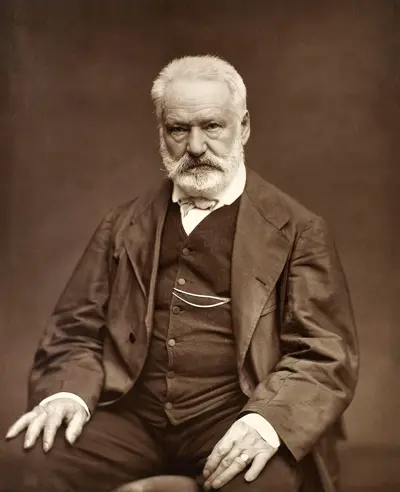
Victor-Marie Hugo was a French poet, novelist, and dramatist of the Romantic movement. During a literary career that spanned more than sixty years, he wrote abundantly in an exceptional variety of genres: lyrics, satires, epics, philosophical poems, epigrams, novels, history, critical essays, political speeches, funeral orations, diaries, letters public and private, as well as dramas in verse and prose.
