Louis Farrakhan Quotes
As a result of that, America desires a moderate Islam; an Islam that America can control; an Islam that America can give direction to and give orders to its leaders.
Farrakhan, Louis. "Saviours' Day Address." Chicago, 29 Feb. 2004.


The party to which he was referring was the Ennahda Party of which he was a founder. Note that party's acknowledgement that Islamic extremists had hijacked the terms "Islamic" and "Islamism", thus requiring them to change vocabulary to distinguish themselves and their more democratic values.


The prohibition of anything new has been one of the reasons for the decadence of Islam over the years. When originated, it was the most modern religion in the world. However as other religions grew and reformed, Islam has not and resists all new things. Christianity which was in the Dark Ages when Islam began, did change including the Protest Reformation so by the end of the 17th century the Christian world was more advanced scientifically, politically, and economically.


The quotation is notable as it illustrates the great difficulty that modern democracies have with extreme Islamic fundamentalists. Their very perception and world view is so different that often we think of the extremists as insane and they often feel the same way about us.

Here Khomeini takes the classic Islamic view of the Koran that leaders should be obeyed unless they do not follow Islam. To the leaders of Islamic nations, this means that even if the state is not a theocracy, the Muslim clergy has the final say as to whether a ruler may justly remain in power since they are the ones who determine if a ruler is properly following Islam.

He was not attributing this to any particular polices or the United States. The U. S. had the so large and was such a force on so many areas that most things the U. S. did would potentially affect every oither nation in the world. There was almost no situation in the world in which the U, S, position and extent of invlovement would not affect the countires involved. At the same time the rapidly accelerating technological change that is changine everything is being led by United States scientists, technologists, and corporations. So if technological change was destabilizing which it was in most societies including America's the United States was the driver. And then, the Presidential election victory of Donald Trump, who had a a stated practice being inconsistant on many things, of aggressivly looking for new ways of doing things in American politics (and had been an exemplar during the campaign), and a strong reluctance to have broad general policies that woild guide his policies and intentions. American politics was changing more than usual with both major political parties were going through major reinvntions and struggles to define themselves. The United States was, moreso than any other country, culturally used to rapid change througout the society and still thriving. But for most other cultures, these things all together could determine the perception of stability and the lac k thereof in most of the world. But even the methods of dealing with climate change which is a source of anxiety for most nations, realsitically depends on what the United States will do or not do and that lack of certainty or even liklihood to prediuct affects people the world over.


Religious obligation of Islam requires all Muslims to try and convert all others. However that is not different from some of the Christian, fundamentalist religions where attempted conversion of non-believers is a duty. However, where many in the Islamic world see that obligation as a peaceful, nonviolent, effort to persuade others to accept Islam, there are many others who believe that Jihad should impose Islamic law—Sharia—upon the world and the use of force and violence is not only acceptable but is necessary and desirable to achieve their objection.
Muslim clerics usually have little education beyond their study of the Koran and other holy books. Unlike most Western clerics who are college graduates, they often have little non-religious sophistication. This quotation is a great example of this. Al-Bouti, interviewed on Syrian TV accuses the United States of something that almost all basic students of political science and international relations know is true of every country including his own. However, the fundamentalist Muslim is supposed to be governed in all things by only one thing—the word of Allah as revealed by His Prophet Muhammad. So he believes that good, moral nations—especially Islamic ones will view the entire world, not through the lens of self interest but through the Koran. Syria, in particular, is one of the most selfish and least moral nations in its diplomacy and foreign policy and much of its activity would even be considered morally wrong by most moderate Islamic clergy.
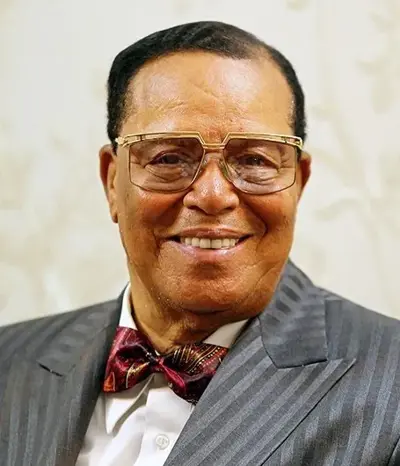
Louis Farrakhan is an American religious leader, political activist, and anti-Semite who heads the Nation of Islam (NOI). Earlier in his career, he served as the minister of mosques in Boston and Harlem and was appointed National Representative of the Nation of Islam by former NOI leader Elijah Muhammad.
