Matthew Hale Carpenter Quotes
Annexation [of Mexico] … because the United States is destined to supplant all other governments on this continent [and] … leading Mexico to a higher plane of civilization.
Mexico was in a chaotic state with the central government not able to control the countries, especially in the North. There were numerous American proposals like this one. See {596782}.
Matthew Hale Carpenter, 1824-1881, U.S. Senator (Republican, WI), Letter to William Stark Rosecrans, U. S. Ambassador to Mexico, February 24, 1870
Sourced by: Eigen's Political and Historical Quotations

Mexico was in a chaotic state with the central government not able to control the countries, especially in the North. There were numerous American proposals like this one. See {596921}.


Buchanan was then Secretary of State.


Albert succeeded his dead uncle, Leopold, whose Belgian Congo colonization was particularly rapacious. His statement was a signal that the colonial abuses were to stop.


America had declared war on Mexico and President Polk had designs on California and other territory.

Between a purchase of lands from the Hudson's Bay Corporation and land grants, Canada annexed millions of acres of land without much political activity or any assent from the people who lived on those lands.


Most of her modern admirers tend to repress this quotation which is very embarrassing for most modern conservatives. However, there is a minority of thinkers who maintain that land, unused, is open to anyone who will make use of it to improve civilization. Many conservationists, in contrast, extol unused land for preservation.


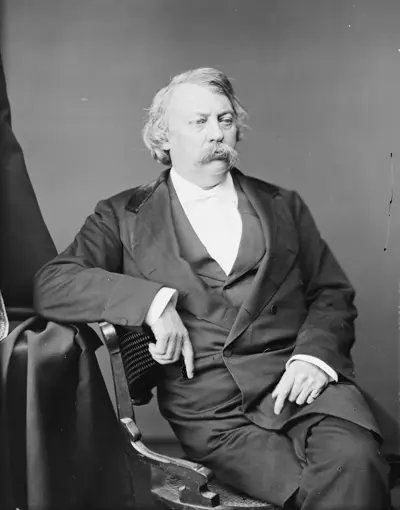
- Born: December 22, 1824
- Died: February 24, 1881
- Nationality:
- Profession: Habeas Corpus
Matthew Hale Carpenter was an American attorney and U.S. Senator representing the state of Wisconsin. He served in the Senate from 1869 to 1875 and again from 1879 to 1881. Recognized as an authority on constitutional law, he made some of the most important legal arguments of 19th-century America. Carpenter presented cases before the U. S. Supreme Court involving such matters as states' rights and regulation of corporations.
