Friedrich Engels Quotes
By the same right under which France took Flanders, Lorraine and Alsace, and will sooner or later take Belgium — by that same right Germany takes over Schleswig; it is the right of civilisation as against barbarism, of progress as against stability.
Engels, Friedrich. "The Danish-Prussian Armistice." Collected Works, by Karl Marx and Friedrich Engels, vol. 7, International Publishers, 1977, p. 422.


Buchanan was then Secretary of State.

Mexico was in a chaotic state with the central government not able to control the countries, especially in the North. There were numerous American proposals like this one. See {596782}.

In that year Republican President William McKinley reversed Cleveland’s policy against expansionism at the expense of independent peoples. He staved off annexation while he was president because of his views as early as 1893. See {643147}.

America had declared war on Mexico and President Polk had designs on California and other territory.

‘Amalgamated’ was a euphemism for ‘being taken over by’. Ito was assassinated shortly thereafter by a Korean patriot who objected to Ito’s takeover of his country.

This quotation is a good illustration of a practice that existed in the age of Empire where two or more large powers would agree among themselves as to which one of them had the right to seize a smaller power, not part of the compact.


The Mexican War was as controversial as any war in American History. President Polk ordered action independent of the Congress, In all of American History there have been two Congressional censures of American Presidents. This was one. See {594521} for the other.
Literally the word means “living room” but was an intellectual doctrine which essentially said that Germany, in order to survive as a major civilized society, was justified in conquering the lands of its neighbors—especially those areas which had traditionally ethnic German populations. This conquest would give the German “master race room to expand.

He had concluded that Spain, who then ruled the Philippines, was incompetent, cruel and immoral in its rule, but that the Filipinos were not educated or sophisticated enough to rule themselves. However, he felt that he had to protect our commercial interests in the islands and the region, and was worried that commercial interests of other countries would take over and control the area. Another reason that this is a very important quotation is that it indicates the anti-Catholic bias in America at the time. Note that the President stated that one objective was to “Christianize” them. However, Spain had been in the islands for over 300 years and most Filipinos were already Roman Catholic. However, Roman Catholics were then a much smaller proportion of the American population and many Protestants didn’t think Catholicism was a legitimate Christian Religion. When the majority of Americans thought of Christianizing other people, they thought of Protestant missionaries much like England. At the time there was very little criticism of the President for the “error” of stating that Filipinos should be Christianized when they were so already Spanish Colonial Policy and Practice was generally terrible and particularly so in the Philippines, See {629450}.

Most of her modern admirers tend to repress this quotation which is very embarrassing for most modern conservatives. However, there is a minority of thinkers who maintain that land, unused, is open to anyone who will make use of it to improve civilization. Many conservationists, in contrast, extol unused land for preservation.

He was referring to land where there were people already living. People included Indians and Mexicans. He was one of the few American Presidents who were not enthusiasts for Manifest Destiny and expansionism of America.


England had made diplomatic inroads in Holland and was with most Dutch more popular than France. There was also a lot of trade between Holland and England. Napoleon wanted to break the English-Dutch relationships.
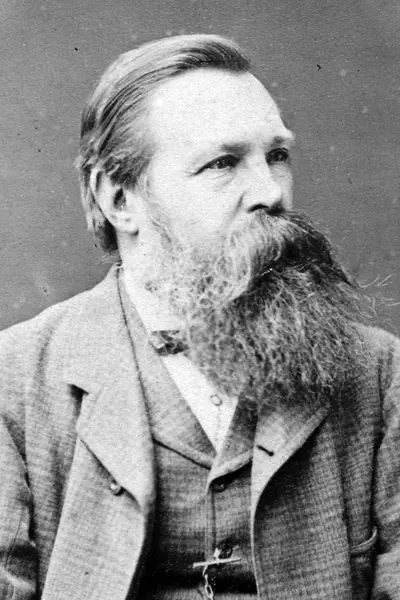
Friedrich Engels (/ˈɛŋ(ɡ)əlz/ ENG-(g)əlz, German: [ˈfʁiːdʁɪç ˈʔɛŋl̩s]), sometimes anglicised as Frederick Engels, was a German philosopher, economist, historian, political theorist and revolutionary socialist. He was also a businessman, journalist and political activist, whose father was an owner of large textile factories in Salford (Lancashire, England) and Barmen, Prussia (now Wuppertal, Germany).
