Nat Turner Quotes
And my father and mother strengthened me in this my first impression, saying in my presence, I was intended for some great purpose, which they had always thought from certain marks on my head and breast.
In 1831 a slave preacher, Nat Turner, led a rebellion in North Carolina killing over 50 white men. Even though Turner and the rebels were captured and executed, whites throughout the South, took vengeance on any slaves they could find.
Nat Turner, 1800–1831, Slave and Slave Revolt Leader, The Confessions of Nat Turner, The Leader of the Late Insurrections, in Southampton, Va. As fully and voluntarily made to Thomas R. Gray, 1831
Sourced by: Eigen's Political and Historical Quotations


This leading “conductor” of the Underground Railroad carried a loaded pistol which she brandished if escaping slaves would get discouraged and not follow instructions endangering the others or the organization itself. The Underground Railroad referred to the clandestine method that Tubman and other “conductors” would risk their own lives by going down South and guiding escaped slaves through a series of safe houses and locations “stations” until they reached Canada where slaves could not be legally recaptured.

Many people erroneously attribute this quotation to Margaret Sanger, who had observed that the upper class women generally knew how to practice birth control and could obtain the devices that were available at the time while the poor and uneducated knew very little and not only did not have the money to obtain birth control devices, but the laws made it illegal so that no one dared to promote it. Du Bois was in many ways, a Black elitist and this quotation reflects that.

1st Earl Baldwin of Bewdley. Despite his claim of divine selection, Baldwin’s policies, though well-intentioned, left England weak and in his great desire for peace led hip to support Neville Chanberlain and his craven appeasement of Germany at the beginning of WWII.
This is an example of how values in politics can get complex. Family Leader put together The Marriage Vow, a pledge it wanted political candidates to sign. The pledge dealt with marital fidelity and other traditional family values. Two Republican Presidential Nomination Candidates signed the pledge rapidly as many of their competitors had notorious affairs and/or had been divorced. The 2 signers thought that they would obtain a substantial advantage. However, another part of the pledge was dealing with the importance of children being brought up in a 2 parent home, The quotation gives their statement on Black families and illegitimacy. However, they organization was so hung up on the evil of children in single parent households, that they said in the pledge that Blacks were better off under slavery than they are under Barack Obama—the first Black President. As might have been expected, there were no Blacks and even very few racist whites who would claim Black children and families were better off under slavery. They two politicians, Michelle Bachman and Rick Santorum—neither very sensitive to minority issues and perceived by most Blacks as racists—began to back away from their signing, First Leader, then removed the quoted paragraph from all copies of the signed pledges and removed it from their website. However, original copies—including the quoted paragraph—got into the hands of the media and the scandal began. Family Leader, trying to do damage control, wisely apologized. The other Republican Presidential aspirants both monogamous and otherwise, refused to sign but what it is that made them refuse was probably different for each person.

The first sentence is inscribed on the Jefferson Memorial in Washington DC. The last two sentences are rarely quoted.


This song and this musical was a profound attack on the essence of racial segregation at a time when discrimination was legal and practiced throughout the country and almost universally in the South. Southern politicians castigated the song, the show, and especially Hammerstein who they called a Communist for promoting such radical views. Ironically, South Pacific became one of the most frequently produced High School Shows by 1979 and remained so into the 21st century including in the South.


_0_thumbnail_47x47.jpg "The psychical researcher William McDougall.")
This quotation illustrates the extreme distortion of even observed evidence that many racists of the early 20th Century went through. Mcdougall was a Harvard professor and was familiar with the intellectual accomplishments of a number of Blacks including W. E. B. Du Bois who also was a Harvard man who was even superior to most whites at that institution. However his racial ideology could not possibly allow that Negroes could be as accomplished as some of them was. His “creative” explanation given here is that all accomplished Blacks must have had white blood, because only white blood could produce such genius. Note also the emphasis that he places on the historical inability of Negroes to form a nation. McDougall knew little about history as there were many Negro nations created from ancient Biblical times throughs the 19th century. Shaka who not only built a Zulu nation but turned it into an expansionist empire contesting England in the Anglo Zulu Wars of the late 19th century as both entires fought to see which would colonize and dominate much of the South of Africa,

Effective, terse quotation illustrating the research findings that adults who were abused as children tend to become child abusers themselves. Although he was referring to Black parents, the findings have been borne out for all ethnic groups.

The March had begun in Selma with 600 marchers who were brutally beaten and harassed along the way. This brought clergy and lay people from the country over to join the protest march and when King gave the speech the marchers had swelled to 25,000.

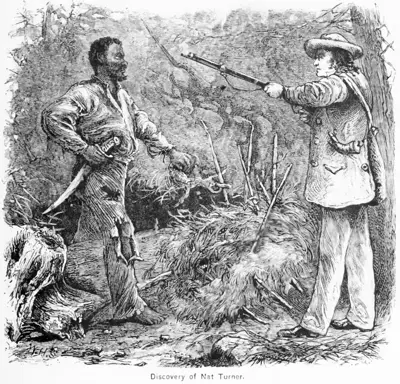
Nat Turner was an African-American enslaved preacher who led the four-day rebellion of enslaved and free black people in Southampton County, Virginia, in 1831. Born into slavery on October 2, 1800, in Southampton County, Virginia, a plantation area with more blacks than whites, Turner was recorded as "Nat" by Benjamin Turner, the man who enslaved him and his family. When Benjamin Turner died in 1810, under then current laws which made human enslavement legal, Nat was inherited as property by Benjamin's son Samuel Turner. For most of his life, he was known as "Nat", but after the 1831 rebellion, he was widely referred to as "Nat Turner". Turner knew little about the background of his father, who was believed to have escaped from slavery when Turner was a young boy. Turner spent his entire life in Southampton County.
