Paul Robeson Quotes
And at home in the United States we found continued and increased persecution, first of leaders of the Communist Party, and then of all honest anti-fascists.
Robeson, Paul. Here I Stand. Beacon Press, 1988, p. 29.


Seeger had been a member of the Communist Party and had left it in 1950. See {635866}. He was later called before the House UnAmerican Activities Committee and asked to reveal the names of others who had been members. In those days of the red scare and McCarthyism, most people asked to name names and not wanting to do so “took the 5th Amendment” and could not be legally forced to reveal the names. Seeger as a matter of principle refused to plead the 5th Amendment because he was not afraid of incriminating himself and had done nothing criminal anyway. So he, a war veteran of WWII, instead refused to answer {635867} citing his First Amendment right of freedom of association. There was no legal precedent for this, and he was indicted and convicted for Contempt of Congress. However, his conviction was overturned as unconstitutional by the U. S. Federal Appeals court. Seeger had prevailed legally. But in retaliation Seeger was blacklisted and none of the radio of TV networks or Hollywood Studios would allow him (and other blacklisted artists) to appear. Today most Americans view what McCarthy, The Congressional Committee, the networks, and Hollywood studios had done as contemptible.


H. S. Tsien was one of the founders of the Jet Propulsion Laboratory and one of the major technical leaders of the American Space and Missile Programs. In the Red Scare of the 1950s some nativist conservative members of Congress and others managed to get his security clearance removed on the grounds that he had Communist Sympathies. Like many other American Citizens, he disapproved of the Chinese dictator Chiang Kai-shek even though Chiang was the anti-Communist bulwark in China. Since his work was space and missiles, he had little professional to do and when Chiang Kai-shek was defeated in China and pushed to Taiwan, H. S. Tsien ended up going to China and starting their rocketry program. (He is known as the “Father of Chinese Rocketry”). He is the only scientist who was an early leader in the space programs of two different nations. Kimball, whose naval missiles were all in part developed by H. S. Tsien’s work, was furious, but at the time with McCarthyism riding high, his criticism was met by accusations that he was a Communist sympathizer.


Seeger’s admission was typical of tens of thousands of Americans who had become disillusioned with the fairness, equity, and effectiveness of capitalism during the depression. They were easy prey for Communist propaganda which pointed out all the problems in American society from legal racial discrimination to lack of a social safety net while at the same time lying about the Russian achievements and hiding the horrible abuses of human rights—especially the political murders of millions of people. Then the truth about Russia emerged, Seeger and so many others abandoned the Communist Party as at the same time America was improving its society and beginning to try and deal with the great problem that had plagued America from its inception—racism and slavery.
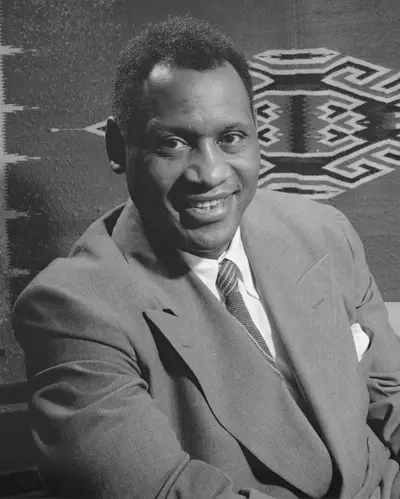
Paul Leroy Robeson was an American bass baritone concert artist and stage and film actor who became famous both for his cultural accomplishments and for his political activism. Educated at Rutgers College and Columbia University, he was a star athlete in his youth. He also studied Swahili and phonetics at the School of Oriental and African Studies in London in 1934. His political activities began with his involvement with unemployed workers and anti-imperialist students whom he met in Britain and continued with support for the Republican cause in the Spanish Civil War and his opposition to fascism. In the United States he became active in the Civil Rights Movement and other social justice campaigns. His sympathies for the Soviet Union and for communism, and his criticism of the United States government and its foreign policies, caused him to be blacklisted during the McCarthy era.
