Winston Churchill Quotes
[American colonists] had no common national tradition except that against which they were revolting.
Winston Churchill, 1874-1965, British Prime Minister (Conservative), A History of the English-Speaking Peoples: The Age of Revolution, 1957
Sourced by: Eigen's Political and Historical Quotations


In most revolutionary settings leaders have to persuade people who have voted with no success to turn to the rifle. In Ireland at this point, almost all the nationalsits knew that the rifle would help them but they were not sure that a vote would have the effect of a bullet.


In 1837 and 1839 there were insurrections in Lower Canada against British rule. The British put down the rebellions and executed a few of the leaders.

This was written by a French Journalist who had been assigned to America for 7 years when he wrote this in 1939. WWII was just breaking out in Europe.

For his seditious activities he was sentenced to penal servitude for life. He escaped and came to America where he entered politics


While Adams was a little hyperbolic in his claim, the vast majority of the colonists who were protesting British policy and administration in 1775 were seeking reform, not separation from England. But what a difference a year made! British reaction radically changed the objectives of most colonists. See George Washington {613171} for a similar view.
The organization sent 2,100 volunteers to fight for South American independence from Spain.
He had been King of Portugal and then had come to the Portuguese colony of Brazil where he led a revolution against Portugal, declared independence from the “mother country, and was elected as Emperor of Brazil. The Colony was much larger and richer in natural resources than the “mother country.”


The professor was lecturing to British university students about 75 years after the American Revolution. The “American War” is the term the British use for the American Revolution.

At the partition if India into Hindu and Muslim States, what is now Bangladesh, was a part of Pakistan called “East Pakistan” by the Pakistani government. While India became a thriving democracy, Pakistan with its combination of military strongmen and Islamic Fundamentalists did not fare as well and became a very corrupt, undemocratic military nation. East Pakistan was not contiguous with the rest of Pakistan and was culturally quite different and less religiously fundamentalist. While all Pakistanis suffered from poor government, the East Pakistanis fared worse. Finally, they developed their own identity which was suppressed by the military dictators of Pakistan and the Banglas revolted and Bangladesh became and independent nation.


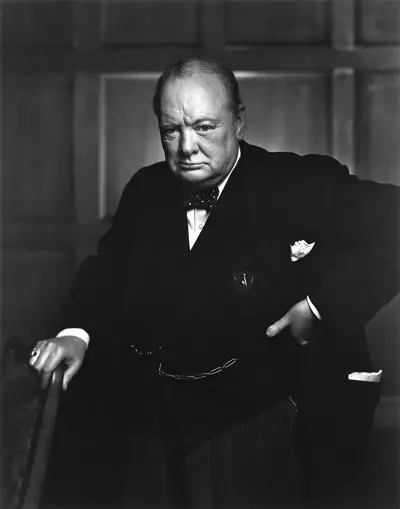
Sir Winston Leonard Spencer Churchill, KG, OM, CH, TD, DL, FRS, RA was the Prime Minister of the United Kingdom from 1940 to 1945, during the Second World War, and again from 1951 to 1955. Apart from two years between 1922 and 1924, Churchill was a Member of Parliament (MP) from 1900 to 1964 and represented a total of five constituencies. Ideologically an economic liberal and imperialist, he was for most of his career a member of the Conservative Party, as leader from 1940 to 1955. He was a member of the Liberal Party from 1904 to 1924. Churchill was also well known for his military career and as a historian, painter and writer, and among his many awards was the Nobel Prize in Literature.
