Jose de San Martin Quotes
My promises to the people for whom I have waged war have been fulfilled — to accomplish their independence and leave the choice of their rulers to their own will. The presence of an unfortunate soldier, however disinterested he may be, is not desirable in newly constituted states. On the other hand, I am tired of having it said that I wish to make myself King. In short, I shall always be ready to make the ultimate sacrifice for the liberty of the country, but as in the character of a simple private citizen and in no other.
Jose de San Martin 1778-1850, President of Peru, Farewell address to the Peruvian people, September 22, 1820
Sourced by: Eigen's Political and Historical Quotations


In most revolutionary settings leaders have to persuade people who have voted with no success to turn to the rifle. In Ireland at this point, almost all the nationalsits knew that the rifle would help them but they were not sure that a vote would have the effect of a bullet.

There is an close similarity between the Dutch revolutionary statements and that of the Founding Fathers of America. The Dutch rebels were very well aware of the American Revolution and the subsequent establishment of a republic, and emulated much of the American experience. They were the first foreign people to be inspired by the American Revolution. Many followed.

See Noah Webster and Timothy Pickering for similar positions. The War of 1812 was very unpopular with the New England states. They had the most developed trade with England and were economically injured by the curtailment of that trade. The citizens of Essex wanted to give the State Legislature the most possible moral and political power to negotiate an end to the war.

South America, invaded and colonized by Spain was a brutal combination of slavery and repression. Even the European colonists suffered under the terrible combination of exploitation, militarism and religious dictatorship. Independence from Spain was equally bloody as unlike in North America where the fight was against British rule, in South America the black slaves, the indigenous Indians and the white colonists all had scores to settle with the Spanish rulers. And the Spanish in turn realized that and brutally repressed all rebellion attempts. Atrocities were common, and committed by almost all, including even idealists like Bolivar.

In 1837 and 1839 there were insurrections in Lower Canada against British rule. The British put down the rebellions and executed a few of the leaders.


See Thomas Jefferson: {605051} for a somewhat similar notion.

For his seditious activities he was sentenced to penal servitude for life. He escaped and came to America where he entered politics


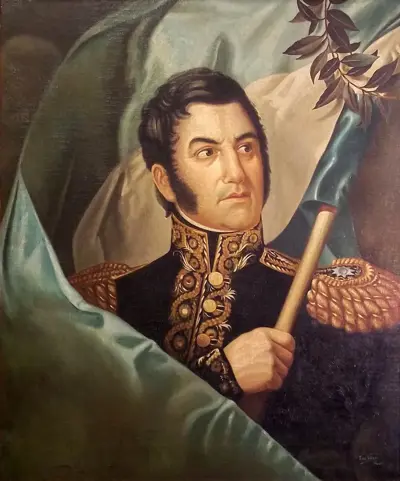
José Francisco de San Martín y Matorras, known simply as José de San Martín (Spanish pronunciation: [xoˈse ðe san maɾˈtin] (listen)) or El Libertador of Argentina, Chile and Peru, was an Argentine general and the prime leader of the southern and central parts of South America's successful struggle for independence from the Spanish Empire who served as the Protector of Peru. Born in Yapeyú, Corrientes, in modern-day Argentina, he left the Viceroyalty of the Río de la Plata at the early age of seven to study in Málaga, Spain.
