John C. Calhoun Quotes
All the calamities we have experienced, and those which are yet to come, are the result of the consolidating tendency of this government; and unless this tendency be arrested, all that has been foretold will certainly befall us,—even to the pouring out of the last vial of wrath, military despotism.
John C. Calhoun, 1782-1850, Vice President of the United States (Democrat, SC), U. S. Congressman & Senator (Democrat, SC), Quoted in Lord, Beacon Lights of History
Sourced by: Eigen's Political and Historical Quotations


He served as a liaison with the Russian military officers after WWII. As a result he developed friendships with some who told him much about Stalin.

This quotation was extremely damaging to Russian Communism at the time. Goldman had been extremely supportive of the initial Russian Revolution and was an enthusiastic Marxist. She was not the typical conservative who would attack the revolution no matter what the outcome.


McReynolds vehemently dissented with the majority view in Perry v. United States that the government's action was wrong but that the plaintiff was not entitled to relief. His remarks were so vituperative that this, and other, comments, did not appear in the formal record of the court. See {616652} for an even worse private insult of FDR. McReynolds was a virulent ant-Semite and believed that all Backs were inferior to whites and Separate but Equal was fine policy for the nation and he was not sure the “equal” was necessary.

Honore Gabriel Victor Requiti. The French King had just opened the French National Assembly which contained deputies (delegates) from the clergy, the nobility and the people. The King had made what some deputies thought was a very constructive and responsible speech opening the assembly. Mirabeau observed that as long as there was an absolute monarch in place, even a benign one. It was the presence of a monarch itself that was evil.


Fremont and some of the Radical Republicans wanted Lincoln immediately to declare the slaves of the rebelling states free. As a major general in charge of an area, he wrote a military order emancipating all the slaves in his jurisdiction. President Lincoln countermanded the order as soon as he found out. He wanted Fremont to only free the slaves whose owners were actively working against the union. Lincoln needed to hold the border states like Maryland in the Union and was working on a plan whereby slave owners who were loyal to the Union would be economically compensated when their slaves were freed. If loyal slaveholders in Fremont’s area would lose their slaves with no compensation, Lincoln feared that the otherwise loyal border states would be driven to the confederacy thus shifting the balance of power. Lincoln had his own plan for emancipation and would not allow Fremont to alter that. As a result of this speech, the Radical Republicans nominated Fremont to run against Lincoln. For a few weeks he looked like he would run, but then he and Lincoln made a deal. Lincoln fired Montgomery Blair, Fremont’s arch enemy, from the cabinet, and Fremont withdrew from the election.

This quotation is inscribed on the FDR Memorial in Washington DC.
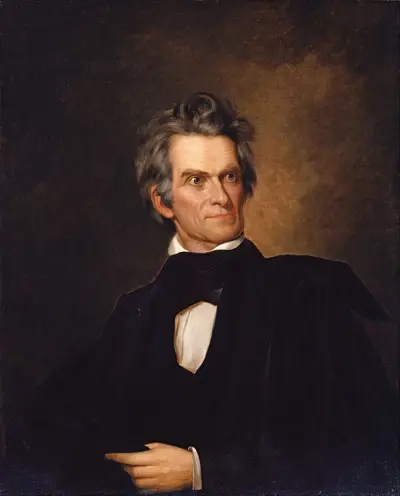
John Caldwell Calhoun was an American politician and political theorist from South Carolina who held many important positions including being the seventh vice president of the United States from 1825 to 1832, while adamantly defending slavery and protecting the interests of the white South when its residents were outnumbered by Northerners. He began his political career as a nationalist, modernizer, and proponent of a strong national government and protective tariffs. In the late 1820s, his views changed radically, and he became a leading proponent of states' rights, limited government, nullification, and opposition to high tariffs. He saw Northern acceptance of those policies as a condition of the South remaining in the Union. His beliefs and warnings heavily influenced the South's secession from the Union in 1860–1861.
