Moises Naim Quotes
All recent U.S. presidents have learned the hard way that, despite their immense power, they remain at the mercy of uncontrollable global forces that render their personal views and campaign promises largely irrelevant.
Moises Naim, Editor of Foreign Policy, “Meet George W. Kerry,” Foreign Policy May/June 2004
Sourced by: Eigen's Political and Historical Quotations


John Foster Dulles was the Secretary of State and brother Allen Dulles was head of the CIA.


In 1995 the president had agreed with our allies to send troops to support a peace in Bosnia if there was one, but many in Congress attempted to block that possibility.


Alberto Gonzalez, White House Counsel and later Attorney General who was forced to resign and David S. Addington, Counsel to the Vice President, had come up with a novel view of the powers of the presidency. They argued that since the President is the Commander in Chief, in a war situation or intelligence gathering thereto, has the Constitutional responsibility for that function, he need not obey any laws of Congress as in the conduct of the war Congress would be impinging on the Constitutional separation of powers which itself was prohibited by the Constitution. The argument did not find any significant legal support but for a while the George W. Bush White House behaved as if this were the law, despite the fact that even in the American Revolution and the War of 1812 Congress passed laws regulating the conduct of the armed forces as is provided for in other parts of the Constitution. Yet even Goldsmith would allow the President some powers that many think are unconstitutional and/or belong to Congress. See {32436}.

Although Hamilton was an advocate of a strong Federal Government, he always advocated checks and balances. Here, he called for checks on the President in the area of foreign affairs which he thought was lacking in the draft of our original constitution. His concern was not addressed and the President still has almost unilateral control over American foreign policy. The only checks are the Senate with the power to ratify treaties or not, and the Congress which need not appropriate money for purposes that the President thinks important, and can condition the money that they do appropriate upon certain limitations on the President’s preferred policies.


He was referring to the Early Cold War. The American official position and propaganda called for Russian military and political control of Eastern Europe to end and supported uprising and revolution, but the U. S. did not have the power to dislodge Russia without risking a nuclear war.

See {588514} for an additional take on the subject.

President Wilson had gone to Paris for peace treaty negotiations. Ex-President Roosevelt was on his deathbed. But even then TR was his politically contentious self.


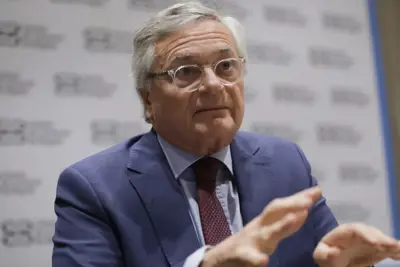
Moisés Naím is a Venezuelan journalist and writer. He is a Distinguished Fellow at the Carnegie Endowment for International Peace. In 2013, the British magazine Prospect listed Naím as one of the world's leading thinkers. In 2014 and 2015, Dr. Naím was ranked among the top 100 influential global thought leaders by Gottlieb Duttweiler Institute (GDI) for his book The End of Power. "The End of Power" was also selected as the first book for followers of Mark Zuckerberg's 2015 book club to read.
