Herbert Hoover Quotes
…a very dangerous and contrary man … I would never see him alone.
Absurd attacks on a presidential opponent’s character have not only been made in modern times. There is a long history of trying to drive up an opponent’s negatives by making almost paranoid accusations. What was so absurd about this particular effort was that one characteristic of FDR that almost everyone agreed upon was his affability and charm. People loved to be with him and speak with him alone. Many conservatives thought that FDR’s policies and programs were dangerous for the country, but other than Hoover, there appears to be no other prominent person who expressed any personal fear of being alone with Roosevelt.
Herbert Hoover, 1874-1964, 31st President of the United States (Republican, IA), Description of. Franklin D. Roosevelt, Campaign of 1932
Sourced by: Eigen's Political and Historical Quotations


Roosevelt’s first gubernatorial term was shaken by the Stock Market Crash and the Failure of the Banks 1929 and the passivity of the Herbert Hoover administration in Washington in coping with the economy and the Great Depression. Reform of Tammany Hall and other State problems took a back seat to trying to create jobs and stabilize the state economy. The Republican candidate Tuttle could not argue against FDR’s economic policies as he would then have to defend President Hoover who was becoming exceedingly unpopular. So he went after the corruption of the Tammany Hall Machine and Roosevelt’s relative passivity. The voters were ok with FDR’s priorities.


Although obvious oversimplifications, these were key strategic elements of these Presidential campaigns.
The ride was the 1933 inaugural where the outgoing President rode down Pennsylvania Avenue with his successor. Roosevelt had tried to engage Hoover in conversation and Hoover refused. For years after that FDR used to tell the story and would imitate Hoover with grunts and facial contortions.

Truman told Kennedy to keep quiet or he would "throw him out the window." Truman was about to physically attack Kennedy he was so angry. Kennedy was a Nazi sympathizer and an admirer of Mussolini and Hitler and this ended his active political career. His oldest son Joe was his favorite, but Joe did not share his father’s fascist inclinations. He not only enlisted for service in WWII but he volunteered for a very risky secret mission on which he was killed. Kennedy blamed Roosevelt for assisting England (he had been the ambassador was pro Hitler and had urged against American involvement) and hence the war. Kennedy’s oldest son Joe, had enlisted to fight Germany. He was a pilot who had volunteered for a very dangerous secret mission in which his plane blew up and he was killed. Joseph Kennedy blamed Roosevelt personally for the death of Joe. Driven out of active politics, Kennedy used his wealth to promote his second son’s political career, and JFK and his brothers had managed thereafter to be politicians in the mold of Franklin D. Roosevelt and reject their father’s political philosophy. To this day, most Americans have no idea that the elder Kennedy held such positions.
Republican members of Congress have been publicly calling Democratic Presidents nasty names at several times in History. When President Barack Obama was called a liar at his State of the Union Message, to most people’s shock and distaste, it was following a history of such insulting behavior. In this instance, everything that FDR had predicted for the Dam turned out to be not only true but was an understatement of the economic benefit. It was finished just in time to power the new Aluminum industry that made all the super-bombers and 750 major ships in WWII. Congressman Kulkin was a minor figure in American history who never accomplished much as a Congressman other to insult the President and question his motives.

This attack stimulated the President to tell his staff what leadership really is. See {641217} .
_0_thumbnail_47x47.jpg)

Hoover, a brilliant administrator before his presidency, was so ideological about the role of government that when the Great Depression came, he was unwilling to use government directly to cope with the new problems. He was turned out of office in favor of FDR and the New Deal which the voters ratified 4 times. Hoover was embarrassed by the New Deal successes and lashed out with many insults. In this case, he called the New Deal “fascist”. See {589568} for another quote where he labels the New Deal communistic. Ironically, Hoover is rated by most historians as one of the least effective Presidents in American history while Roosevelt is always rated among the top 3 presidents.

The implication is that in a political race, it is only the horses ass that runs.


Ryan told the national audience that President Obama had come to a factory in his district that as rumored to be closed. Obama had told the workers that the Federal government could assist and keep the factory open for many years. Then as Ryan explained, the factory closed the following year. He gave this as an example of Obama not keeping his word. However what Ryan did not say was that Obama had made the speech at the factory when he was a candidate for the Presidency, and then the factory was closed while George W. Bush was President and by the time he took office, the closure was done and the factory machines gone. And when Obama took office, our national economy was within days of complete bank and finance collapse. Obama saved most of the banks and then the American automobile industry. To suggest that Obama could have or should have done something for the factory that closed was shockingly misleading. It would have been a minor issue if some party hack had lied and made the same accusation. But this was the Vice Presidential Candidate whose acceptance speech was assumedly vetted by the Presidential Candidate’s staff. That is why the quotation was so memorable.
This was written by a French Journalist who had been assigned to America for 7 years when he wrote this in 1939. WWII was just breaking out in Europe. President Franklin Delano Roosevelt was in his 3rd term of office (of 4) and since George Washington was the most popular American President, yet he had strong conservative critics and enemies.

One of the reason’s that TR was so popular was that he was a very candid, clear and dynamic speaker who always said what he meant and meant what he said.

Referring to Governor Franklin Delano Roosevelt, then contesting for the Democratic presidential nomination:

This is a very subtle put down of politicians.

That was true for Maryland even in modern times. Originally the only Catholic founded colony until modern times had been the buffer between the Southern States and the Northern. In the Civil War, Maryland was filled with passionate advocates for both sides.

This is a wonderful historical picture of FDR on his campaign train. Note that the President liked to listen to ideas of many people. Unlike most Presidents he did not have any particular political programs that he advocated in his campaigning. He had no immediate answers to the Great Depression that he had inherited from the Hoover administration. But unlike Hoover, and most Presidents, he was willing to try ideas for which there was no advance evidence of success. If that did not help, he would try something else. He sought ideas from anyone and everyone. His enemies called him a weak leader who had no ideology—no principles but just trying unproven solutions to solve the nation’s critical problems. But it worked and he was elected 4 times—the only President who had served even 3 terms.
Her husband had been accused in a newspaper headline of “exemplifying a mollycoddle philosophy”. She immediately responded. This is one of the few times where anyone in the FDR administration ever entioned the fact that the President had been an invalid.
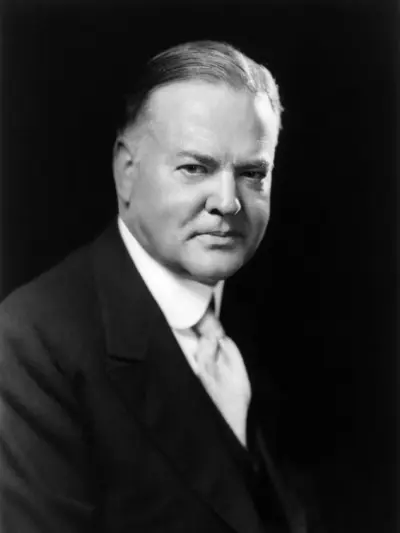
Herbert Clark Hoover was an American politician, businessman, and engineer, who served as the 31st president of the United States from 1929 to 1933. A member of the Republican Party, he held office during the onset of the Great Depression. Before serving as president, Hoover led the Commission for Relief in Belgium, served as the director of the U.S. Food Administration, and served as the third U.S. Secretary of Commerce.
