Benjamin Franklin Quotes
A plentiful Currency will occasion Interest to be low …. many that understand Business very well, but have not a Stock sufficient of their own, will be encouraged to borrow Money; to trade with, when they can have it at a moderate Interest.
Benjamin Franklin, 1706-1790, Governor of Pennsylvania, Member of the Continental Congress & the Constitutional Convention, Governor of Pennsylvania, President of the Pennsylvania Assembly, U.S. Minister to France, Postmaster General of the American Colonies, A Modest Enquiry into the Nature and Necessity of Paper Currency, 1729
Sourced by: Eigen's Political and Historical Quotations

North was none-the-less in favor of allowing interest rates be much higher, but was stating the best argument, believed at the time by most English experts, and many American economists today.


All money has based on the Gold Standard then. But the economic output of the American colonies was increasing rapidly. If the money supply stays fixed, there is a shortage of money and this then inhibits further growth, Franklin realized this and called for an increase in the money supply. He was only 23 years old when he wrote this essay and had these insights.


After the Great Recession the Mexican bankers, like their American counterparts, tightened their credit standards so much that the only people who could get loans were the ones who didn’t need it. If banks do not make loans, it matters not that they are solid institutions that are well capitalized.
There must be enough money in circulation so that all people who want to buy things will have a vehicle for paying for it else people would be reduced to barter and tade—a much less efficient mechanism. Note the importance that Franklin gives to being able to attract immigrants. This was considered extremely important in colonial America. Immigration was the main engine of growth and development. Many believe that it still is.


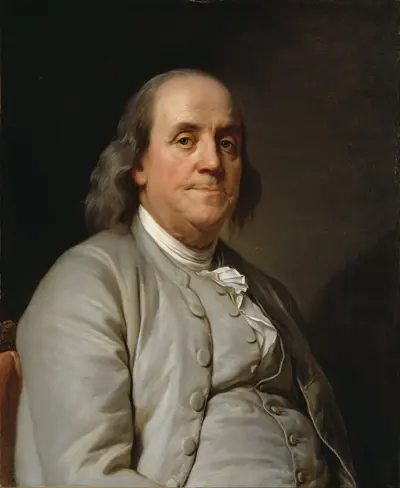
Benjamin Franklin FRS FRSA FRSE was one of the Founding Fathers of the United States. A polymath, he was a leading writer, printer, political philosopher, politician, Freemason, postmaster, scientist, inventor, humorist, civic activist, statesman, and diplomat. As a scientist, he was a major figure in the American Enlightenment and the history of physics for his discoveries and theories regarding electricity. As an inventor, he is known for the lightning rod, bifocals, and the Franklin stove, among other inventions. He founded many civic organizations, including the Library Company, Philadelphia's first fire department, and the University of Pennsylvania.
