
Context: He was right. Even the vaunted Southern Filibuster was broken by the strategy and tactics Johnson and Senator Humbert Humphry, the Floor Leader for the 1964 Civil Rights Bill.
LYNDON B. JOHNSON
(Lyndon Baines Johnson)
Context: Johnson at the time was the Senate Majority Leader. The legislation was developed in the office of President Eisenhower’s Scientific Adviser James Killian and was then shortly submitted to Congress without the military having much of a chance to comment. Eisenhower with his suspicion of the military industrial complex already forming, established NASA as a civilian agency with no military control and little military involvement. The legislation moved so quickly that the military industrial complex never able to get organized enough to block or amend the legislation.
Context: Congressman Carl B. Albert was the chairman of the 1968 Democratic National Convention when the street demonstrations and the police tactics entered the convention debate in front of a nationwide television audience. The President, watching on television, was horrified and called Congressman Dan Rostenkowski who was manning the telephones backstage. Rostenkowski followed the President's order and was never forgiven by Albert who, when he became Speaker, refused to appoint the Rostenkowski as whip, choosing Tip O'Neill instead.
Context: It was the first American use of the phrase, "Great Society" which had been penned by Johnson speechwriter, Richard Goodwin, a few months earlier for a speech which the President never gave. Johnson asked that the phrase be incorporated into this speech. The first political use of the phrase appear to have been in 1952. See Aneurin Bevan.
Context: The job of the Community Relations Service was to provide mediation and other services to promote voluntary desegregation in communities. Most Southern politicians were urging non-compliance with the Civil Rights Act, and to be a federal official who tried to persuade Southerners to desegregate was not good for a political career. Collins, to his great credit, accepted the President’s offer. Johnson’s “sales pitch” was the altruistic and patriotic side of the President which often gets overshadowed by his political machinations.
Context: Thereafter Ball argued against the Vietnam War at every staff meeting where it was discussed. The President never cut him off. With the exception of Chief of Staff Marvin Watson, none of the other staff members realized that Ball was following the directions of the President, and tended to be annoyed with him for constantly opposing the war.
Context: While a Congressman under the Truman administration, Johnson was critical of federal measures to enforce civil rights.
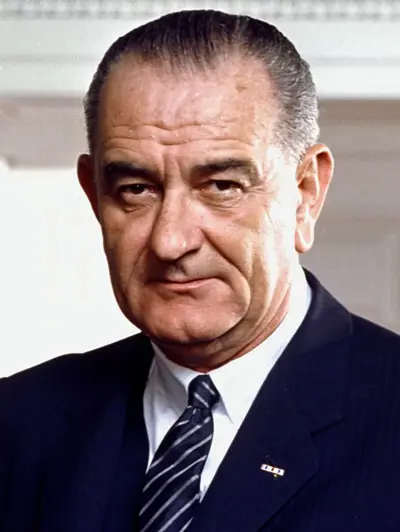
Lyndon Baines Johnson, often referred to by his initials LBJ, was the 36th president of the United States, in office from 1963 to 1969. He served as the 37th vice president from 1961 to 1963 and assumed the presidency following the assassination of President John F. Kennedy. A Democrat from Texas, Johnson was also a United States representative and later majority leader in the United States Senate. Johnson is one of only four people to have served, at various times, in all four federal elected positions.
Related Authors
