Josiah Wedgwood Quotes
You have sent us a rich man, untrained in diplomacy, unlearned in history and politics, who is a great publicity seeker and who is apparently ambitious to be the first Catholic President of the United States.
Kennedy’s pro Nazi and pro Hitler stance and statements when Ambassador to England, destroyed him politically in the United States. However, we transferred his political ambition to his sons, and JFK became the first Catholic President of the United States.
Josiah Wedgwood, 1872-1943, Member of British Parliament (Liberal), Referring to the then newly appointed Ambassador to Great Britain Joseph P. Kennedy, 1888-1969, Quoted in Ronald Kessler, The Sins of the Father
Sourced by: Eigen's Political and Historical Quotations

This quotation illustrates an interesting phenomenon in American Presidential Politics. There have been Democratic Presidents (FDR and Obama are the most glaring examples) for whom there was vituperative hatred and derision from the conservative Republicans who would frequently refer to them as Socialists and would believe that they were trying to lead the country on the path to socialism. The Presidents always stated that they were opposed to socialism, but to little avail with their conservative haters. But the socialists of the times and even the left wing of the Democratic Party not only did not see them as socialists, but were not very supportive or complementary of their skills and capabilities. Roosevelt reveled in the situation and “welcomed: their hate. Obama was more of a public centrist who tried to avoid the president getting involved in the extreme partisanship of the day.

"Imperium" is a Latin word which, in a broad sense, translates roughly as 'power to command'. In ancient Rome, different kinds of power or authority were distinguished by different terms "Imperium" referred to the sovereignty of the state over the individual—Wikipedia. The Consul was a wonderful diplomat. He had no respect for the South not only because they were fighting to maintain slavery, but also he found most of their diplomats and officials very incompetent. He found it hard to participate in all the Confederate ceremonies as he was their exhibit number one that they had International Recognition and they "exhibited him frequently. Despite this he was charming and never argumentative about slavery or other political positions that he loathed. As a matter of fact, the Southern Diplomats regarded him as a man sympathetic to the South with an understanding of their point of view. As a result he gained a huge amount of intelligence which he regularly dispatched back to London. England was neutral {35520} in the Civil War, but England did not recognize the Confederacy as a nation, else they would have sent an ambassador. The Southern politicians worked hard to get him to carry their message that if they would be recognized, they would grant England many favorable trade advantages as the English textile industry really wanted Southern cotton. While apparently sympathetic to the Southern cause, his reports contained all the negative information about the South and counseled against recognition just as the English Ambassador in Washington did—see {583131}.


Storer was a major Washington socialite who was very influential. Despite his misgivings, the President did appoint Roosevelt.

Samuel Langhorne Clemens, 1835-1910. Ambassadors were often given title of Minister in those days.


Turkey with the decline of the Ottoman Empire, had little experience in modern international politics—and no modern leaders until Ataturk came and modernized the nation. The Turks had allied themselves with Germany in WWI and in the aftermath came out as badly in the peace as they had in the war.


Patton always believed that Eisenhower wanted to be President. At the beginning of the war Patton was much senior to Eisenhower, but President Roosevelt promoted Eisenhower above many more senior generals. Eisenhower thought Patton the best fighting general in the army, but a public relations and administrative problem. Several times when he had gone too far, Eisenhower reprimanded him but kept him in his command position. After the fighting was over, Patton became the military governor of part of Germany and was not as successful at peacekeeping and nation building as he was at fighting. Eisenhower was convinced that Patton would destroy himself and get fired by the army command and the President if he continued as governor. Patton confused Eisenhower’s prudent and politic demeanor with the allies as a lack of courage. And Patton could never get over the fact that Eisenhower and never commanded an army fighting in the field. He was jumped to Supreme Allied Commander, in a very bold and brilliant stroke by FDR who passed over many senior generals.
As a young Senator JFK had called for Algerian freedom from French rule. The French ambassador was not even upset.


Mordecai Manuel Noah, 1785-1851, was the first Jewish Ambassador of the United States representing us in Tunisia. However, President James Monroe removed him from office.

This is an important quotation because it was believed by most of the Founding Fathers and the American public until relatively recently. Presidential candidates would not think of publicly campaigning. The view was that anyone who was ambitious for power and authority should not be trusted with it. The idea was first stated by Plato and has been a major view of Western politics since. Many still believe it, but no one has come up with a practical alternative in a large jurisdiction where there is no way to know about the possible candidates without their initiative. Earlier American presidential candidates, although they did not campaign as we know it, got associates to do their campaigning for them. At Presidential nominating conventions, candidates would not even attend. Abraham Lincoln for example never attended the convention at which he got nominated, but he had associates lining up delagates and he was managing their efforts behind the scenes.


Kennedy hated Roosevelt who had forced him to resign as the U. S. Ambassador to England. Kennedy was an admirer of Mussolini and Hitler. He had allied himself with the part of the British aristocracy that was pro Fascist and opposed Winston Churchill and the democratic element in Britain. Kennedy had opposed aid to Britain to fight Hitler and advised all who would listen that Britain could and would not stand up to Germany. Roosevelt’s support of Britain with Lend Lease and other means proved Kennedy wrong pragmatically and Kennedy’s own statements had forever proved him wrong morally. Although Kennedy opposed our entry in WWII, his sons did not. His oldest son volunteered for a very dangerous mission and was killed. Kennedy blamed his death on Roosevelt {616651} and forever after slandered FDR whenever he got a chance until his son Jack got into politics when his ambition for his son outweighed his hatred.

First woman to receive the British Order of Merit. Nightingale was a great and prolific writer, and nothing attracted her ire worse than bureaucracy. See {614057}.

Huntington and his associates were used to bribing Congressmen to vote for favorable railroad legislation.


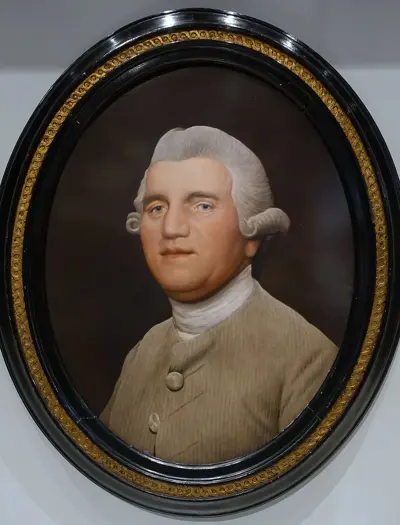
Josiah Wedgwood FRS was an English potter, entrepreneur, and abolitionist. He founded the Wedgwood company. He developed improved pottery bodies by a long process of systematic experimentation, and was the leader in the industrialisation of the manufacture of European pottery (the Chinese having achieved this long before).
