Joseph P. Kennedy Quotes
Winston Churchill is an entirely bellicose individual…no long term views
Joseph P. Kennedy, 1888-1969, U. S. Ambassador to Great Britain (Democrat), Chairman, Securities & Exchange Commission, Father of President John F. Kennedy, Statement to Herbert Hoover, ~1939, Kennedy when ambassador had allied himself with the part of the British aristocracy that was pro Fascist and opposed Winston Churchill and the democratic element in Britain. Kennedy had opposed American aid to Britain to fight Hitler and advised all who would listen that Britain could and would not stand up to Germany. Churchill’s leadership and Roosevelt’s support of Britain with Lend Lease and other means proved Kennedy wrong pragmatically and Kennedy’s own statements had forever proved him wrong morally.]
Sourced by: Eigen's Political and Historical Quotations

Precursor to CIA. WWII had begun in Europe and England was under great pressure as Hitler threatened invasion and the German military had been successful everywhere they tried to invade. FDR had received an intelligence report and advice from our Ambassador to England, Joseph P. Kennedy (JFK’s father). He told the military, the State Department, and the President that England was finished—that they would not be able to stave off the coming German invasion. He predicted that Germany would set up a puppet state. Any help America could supply would not only be wasted but if material, would fall into the hands of the Nazis and be used against us. {610109} The military attaches attached to our Embassy in England generally agreed. However, the President knew that not only did Kennedy dislike Winston Churchill {613151}, but he had been an admirer not only of German Fascism, but Hitler in particular. Kennedy ran around with some of the wealthy, aristocratic English Fascists who were advocating a negotiated surrender to prevent English civilian casualties. So FDR sent his friend, Donavan, to make an independent Assessment. Donovan had served as an officer in WWI and had earned the Medal of Honor. This quotation was the summary of Donovan’s recommendation. Based on Donovan’s report, and other information, the president had gathered and his geopolitical judgment, FDR provided aid to England (Lend Lease) and fired Kennedy, who had disliked Roosevelt before and this turned to hate and became a vendetta for Kennedy thereafter, especially when his oldest son Joe volunteered to serve in the war, that the Ambassador had so viciously opposed, {610121} and then was killed while carrying out a very dangerous volunteer mission. {616651}.

Kennedy hated Roosevelt who had forced him to resign as the U. S. Ambassador to England. Kennedy was an admirer of Mussolini and Hitler. He had allied himself with the part of the British aristocracy that was pro Fascist and opposed Winston Churchill and the democratic element in Britain. Kennedy had opposed aid to Britain to fight Hitler and advised all who would listen that Britain could and would not stand up to Germany. Roosevelt’s support of Britain with Lend Lease and other means proved Kennedy wrong pragmatically and Kennedy’s own statements had forever proved him wrong morally. Although Kennedy opposed our entry in WWII, his sons did not. His oldest son volunteered for a very dangerous mission and was killed. Kennedy blamed his death on Roosevelt {616651} and forever after slandered FDR whenever he got a chance until his son Jack got into politics when his ambition for his son outweighed his hatred.


Cunningham was part of an American Diplomatic Delegation negotiating with the Vietnamese. He had been an Naval Ace Fighter Pilot during the Vietnam War. He was notorious for his lack of tact.


that MacArthur should command the final assault on Japan. The Atomic Bomb later made the final assault unnecessary. Almost every officer who worked with MacArthur—except those on his personal staff—found him an overbearing egomaniac who was militarily capable, but nowhere near as capable as he saw himself. In success he rarely shared the limelight with anyone else, but would rarely take the blame when things were not as successful as all had hoped. Stimson and President Roosevelt had decided that MacArthur should lead the invasion on Japan, and discovered all this hostility amongst MacArthur’s colleagues. It was much easier to place MacArthur in charge of Post War Japan where he would not work that closely with so many senior officers throughout the services. He did a brilliant job governing Japan but still alienated other senior officers. MacArthur was so egotistical that he thought that he could run the country far better than FDR and in 1944 thought of running against the President.


Hopkins was a social worker with no military of political experience. But the President trusted him implicitly. Most American military officers and Ambassador to England Joseph P. Kennedy, a Nazi sympathizer & father of JFK, believed that England could not stand up to Hitler. Any military aid we gave England would fall into the hands of the Germans. Everyone was shocked when Roosevelt sent Hopkins to England to make a military recommendation. To impress Hopkins with something he thought Hopkins would be interested in, Churchill led a tour of workers cottages built by the government. Hopkins surprised Churchill and his aids who would never forget this statement & then asked to see the military facilities. Hopkins distressed the American military by recommending that Britain could hold out against invasion if they received military aid. Despite the contrary military advice, FDR accepted Hopkins’ recommendations, and the rest is history. He had been right and much of the military wrong.


The quotation was memorialized in the personal notes of Interior Secretary of the meeting. Churchill was a very heavy drinker who was inebriated much of the time.


The inoming President was meeting with and getting briefed by the Director of National Intelligenc, James Clapper and this is the word he used to descrive the American Intelligence Agencies.

“Hapsburg” was the family name of the Emperors of the Austro-Hungarian Empire. As typical of a heredity absolute monarchy, it was accompanied by a heredity aristocracy from which all the generals and senior officers of the military were selected. Their social graces and skills were assured but not their capability as leaders of any kind—especially military officers.

Samuel Langhorne Clemens, 1835-1910. Ambassadors were often given title of Minister in those days.


The French leader was one of the first to warn against the Fascism that Mussolini brought to Italy. Although most of the French leadership was opposed to Fascism when it came to fighting Fascism, the French later proved feeble, and many became collaborators and adopted the Nazi puppet state of Vichy France.


Blair was then the leader of the opposition Labor party. Major, the prime minister, did not have firm control of his own party and was whipsawed between different factions. He was ousted by his own party, not by losing an election.
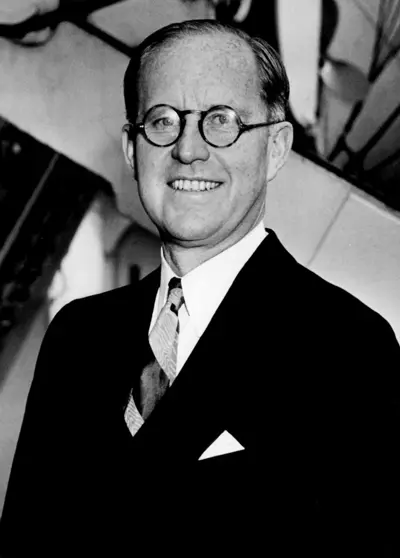
- Born: September 6, 1888
- Died: November 18, 1969
- Nationality: American
- Profession: Diplomat
Joseph Patrick Kennedy Sr. was a prominent American businessman, investor and politician. He is known for his own political prominence as well as that of his children and was the patriarch of the Irish-American Kennedy family.
