Charles Kettering Quotes
You are always too late with a development if you are so slow that people demand it before you yourself recognize it.
Charles Kettering, 1876 -1958, Social Philosopher & Inventor, Quoted in Scientific American, August 1934
Sourced by: Eigen's Political and Historical Quotations


His message is that man has to do something to produce solutions. Problems will come inevitability.


This quotation became the mantra of the MIT Media Lab's Professor Hugh Herr and others whose total efforts are spend inventing things for the future.


Babbage anticipated the digital era when a small number of computer programmers develop a powerful program that can be used by millions of people who have no skill at programming.

See {630440} for an earlier English human relations statement of the idea.

Paulson, Michael Bloomberg and other politicians who had vast business experience were beginning a campaign to show the great danger to the economy of climate change and global warming.

Musk was one of the very few technilogical leaders who had great fear about the potential danger of artifical intelligence and thought that it should be regulated.


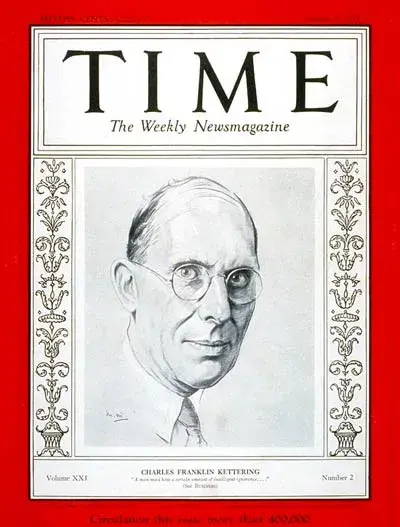
Charles Franklin Kettering sometimes known as Charles "Boss" Kettering was an American inventor, engineer, businessman, and the holder of 186 patents. He was a founder of Delco, and was head of research at General Motors from 1920 to 1947. Among his most widely used automotive developments were the electrical starting motor and leaded gasoline. In association with the DuPont Chemical Company, he was also responsible for the invention of Freon refrigerant for refrigeration and air conditioning systems. At DuPont he also was responsible for the development of Duco lacquers and enamels, the first practical colored paints for mass-produced automobiles. While working with the Dayton-Wright Company he developed the "Bug" aerial torpedo, considered the world's first aerial missile. He led the advancement of practical, lightweight two-stroke diesel engines, revolutionizing the locomotive and heavy equipment industries. In 1927, he founded the Kettering Foundation, a non-partisan research foundation. He was featured on the cover of Time magazine on January 9, 1933.
