Natasha Trethewey Quotes
Writing 'Native Guard,' I didn't know I was working on a single book. I began writing that book because I was interested in the lesser-known history of these black soldiers stationed off the coast of my hometown.
Hall, Joan Wylie, editor. Conversations with Natasha Trethewey. University Press of Mississippi, 2013.


The Mystery was for many years the only Black Newspaper in America.


Ingersoll was considered to be the greatest orator and political thinker of his day, but his overt atheistic views curtailed his elected political career.
This is one of the most eloquent writings on the racial discrimination issue in American History. The young man who wrote it was a free Black born and educated in Troy, New York who became a seaman in New Bedford. He enlisted in the famous Massachusetts 54th Black Regiment. He also sent bi-weekly news dispatches to The New Bedford Mercury. In the midst of the assault on Fort Wagner in Charleston Harbor on July 18, 1863, and in the battle of Oustlee, Florida, on February 20, 1864. In the latter battle, he was wounded and captured. He was murdered by the inhuman conditions in the infamous Confederate prison camp at Andersonville, GA. He was only 27 years old.

This letter was signed by a local white Priest and two other leading planters. This quotation gives us a marvelous feeling for what occurred when parts of the South was occupied by the Union Army shortly after the Emancipation Proclamation was issued. Minor and his fellows just did not “get it.” The concept of freedom of the slaves was intellectually so foreign to them, that they wanted the Union Army to “compel” the freed slaves to work. They were horrified that slaves went wherever they wanted, and they were most outraged when former slaves who had enlisted in the Army, would “visit” their old plantation setting such a terrible example. The letter gives us a perspective on how difficult it was to change the mental set of Southern Whites and why Reconstruction was so difficult. The year of the letter is somewhat uncertain as the original letter appears to be dated 1862 but the writing is not clear and that date does not comport with the history of the era and we believe 1863 was the correct year. The photograph is of the first official colored troops mustered into the Union Army. They were called the Louisiana Native Guards and contained the ex slaves who went over to the Union side just before the time this slave owner complained. These ex slaves, in uniform, and with arms would sometimes visit the plantations where they and been enslaved, thrilling the remaining slaves and infuriating owners like Minor.

The U. S. Navy had Black sailors even before the Civil War. Blacks had shipped out on Northern merchant vessels and whaling ships starting in colonial times. Many Blacks had nautical experience and were welcomed by the Northern Navy and treated very well. The Union Army in contrast was much more ambivalent about Blacks serving. Ironically the Navy was disbanded to save money and when it was reconstituted it was on a racially segregated basis completely foreign to American Naval history. It was the last of the American armed services to integrate and its officer corps has not desecrated as much as the other services.

While this assessment was true up until the 1980s. By the 21st century there were almost no serious historians who thought that the motivation of the Confederate States for the Civil War was anything but slavery and the economic impact that abolition might bring. However, one of your advantages having this collection of historical quotations is that you can see for yourself why the Southern states say they were seceding. This following are four of the official secession resolution documents. Read these and you will see that all the claims that there were other major reasons for secession are just attempts to make the Confederacy a little less brutal and greedy. See {621371}, {619793}, {621372}, {621375}


He stated that he had a vision and made these two prophesies that indeed came true. The first was the South Carolina secession starting the Civil War. The second, when the North used former slaves as soldiers who fought their old masters.

Much of the South was so insular that people knew nothing about the notion of abolition and just assumed that no one would ever consider freeing the slaves. Many never knew that it was the South that first fired on the Union troops and flag. If the North won the war, the assumption was that Northerners would then own the plantations and the valuable slaves. In reality, while all slaves were emancipated in the South, very few plantations and farms were confiscated from their Southern owners by Northerners despite the fact that there was political pressure in the North to confiscate the land of all rebels who had committed treason and use the value to repay the Union bonds and care for the wounded Union veterans and the widows of dead Union Soldiers. Eggleston was an accomplished writer who had served in the Confederate army of the Civil War. 20 year after the war he wrote a series of articles for the prestigious Northern Atlantic Monthly trying to convey the war from the Southerner’s point of view.

At this point, there had hardly been any fighting and no outrages or war crimes were yet committed by either side. These would come later—more on the Confederate side as they did not want to take the limited resources they had from their troops to fulfil abstract obligations to prisoners of war or to civilians. A few deliberately chose to use terror tactics. The Union troops also at various points in the war got out of hand and looted personal property of civilians. But at this point, this proclamation was just lies and propaganda.

Lincoln was worried about Louisiana reverting back to the slavery era. He was right to be worried, and led the fight to pass the 13th Amendment outlawing slavery forever. So the white racist elements of Louisiana used Jim Crowe discrimination instead.

At the time, the prevailing federal policy was to return fugitive slaves to their owners. Lincoln was intent on keeping Kentucky and Maryland, both slave states, in the union, even at the cost of returning fugitive slaves. Shortly after, he came up with the policy of always returning fugitive slaves except in the rebellious states of the confederacy where the slaves were legally defined as ‘contraband’—war material, and thus could be seized by Union forces. Many fugitive slaves were thus employed by the Union for construction projects. Later, the Emancipation Proclamation set the slaves of the Confederacy free.
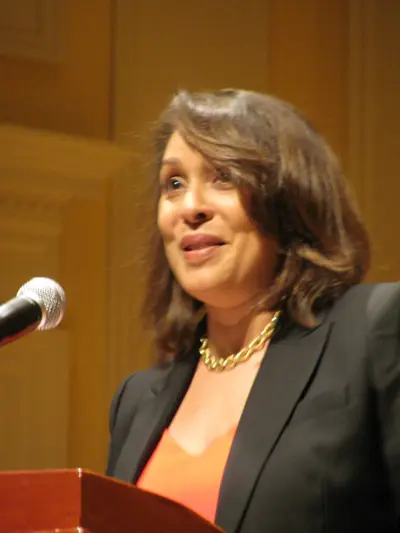
Natasha Trethewey is an American poet who was appointed United States Poet Laureate in 2012 and again in 2013. She won the 2007 Pulitzer Prize in Poetry for her 2006 collection Native Guard, and she is a former Poet Laureate of Mississippi.
