Elizabeth Cady Stanton Quotes
... women learned one important lesson--namely, that it is impossible for the best of men to understand women's feelings or the humiliation of their position. When they asked us to be silent on our question during the War, and labor for the emancipation of the slave, we did so, and gave five years to his emancipation and enfranchisement.... I was convinced, at the time, that it was the true policy. I am now equally sure that it was a blunder.
Stanton, Elizabeth Cady, et al., editors. History of Woman Suffrage. Vol. 2, Fowler & Wells, 1882.


The editorial was in support of women’s suffrage—the right to vote which at the time women did not have in Britain. Women were very active in protests and demonstrations. Tactics sometimes involved civil disobedience and chaining themselves to public buildings. It was the civil disobedience and disruptions that the newspaper referred to as the “follies and excesses.” In retrospect today, it is amazing how threatened the society felt and how they reacted to the “threat” of females voting. It does however give us a perspective on those contemporary societies which restrict women’s voting rights.


Referring to new laws that would be necessary after a proposed Declaration of Independence:


Although born and educated in the United States, she lived mostly in England and was politically active there.

The classification of women with criminals and lunatics referred to the fact that at this time Women could not vote in New Zealand or any other nation of the world. The following year, much as a result of her efforts, New Zealand became the first country in the world to allow women to vote.


Abbot was apparently ignorant of the American women who did fight in the American Revolution, the War of 1812 or the Civil War where there were a few women who fought on both sides some of whom were decorated. Nor did he seem to acknowledge Joan of Arc and other female warriors in world history. But he would be truly shocked by the tens of thousands of “civilized” women who volunteered and served in the American military once they were allowed to do so and the “civilized” men who fought with them as compatriots.

First female presidential candidate & first divorcee to run for that office
The Bible and the Church have been the greatest stumbling blocks in the way of women’s emancipation.
The most important documents and doctrine of most churches were created by men who also established the framework of the religion. The result has in almost all cases been a sexist structure with women having not only little power not typically females are banned from all church governance. See {640303} for her quote on religion in general vis a vis women.
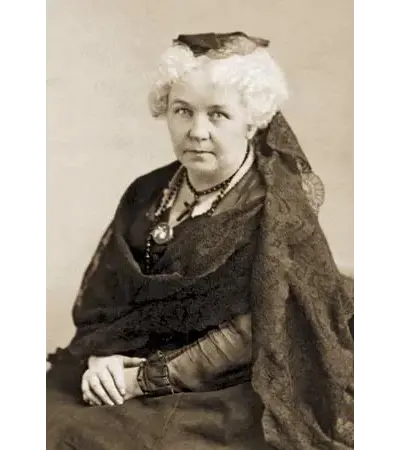
Elizabeth Cady Stanton was a leader of the women's rights movement in the U.S. during the mid- to late-1800s. She was the main force behind the 1848 Seneca Falls Convention, the first convention to be called for the sole purpose of discussing women's rights, and was the primary author of its Declaration of Sentiments. Her demand for women's right to vote generated a controversy at the convention but quickly became a central tenet of the women's movement. She was also active in other social reform activities, especially abolitionism.
