John Quincy Adams Quotes
Why take sides in the fractious squabbles of a quarrelsome continent?
John Quincy Adams, 1767-1848, 6th President of the United States (Independent, MA), Advice regarding foreign policy toward England and Europe
Sourced by: Eigen's Political and Historical Quotations


Senator Burton was using this quotation to support the Republican isolation policy that they were advocating at the time. This quotation has been cited by almost every American politician advocating isolationism. Generally it was the Republican party that has been the isolationist advocates in America. However, after the Second World War that began to change, and in the beginning of the 21st century, the George W. Bush Administration, without any declaration of war by Congress, attacked and invaded two different countries starting the Iraq and the Afghanistan Wars. Meanwhile, the Democrats, who had been advocating American activism in foreign affairs also flip flopped and opposed foreign military intervention as Democratic President Obama withdrew American troops from the two Bush wars. The Afghanistan War was the longest war in American history.


Galloway, a witness before the committee who had always criticized the American and British Policy of Iraq invasion to eliminate weapons of mass destruction, had also predicted the insurrection and resistance to the American and British occupation had been attacked by Coleman for taking campaign contributions from British Islamic terrorists—see {616260}. Coleman expected the typical American hearing behavior where Senators can berate witnesses who generally behave docilely in defending themselves. He was not used to the English style of political debate which is much more aggressive and Colemen was nonplussed when Galloway came up with this put down.

This is one of the favorite quotations of American isolationists. Try as he and others did, they found the principle easier to utter than implement. Jefferson, having diplomatic experience in Europe knew far more than most Americans about foreign affairs, and he used this knowledge well on many occasions in playing off the French, Spanish and English against each other regarding their interests in America. By purchasing the Louisiana Territory from Napoleon, he not only greatly increased the size of the nation but all but eliminated Spanish aspirations in North America. At the same time the money he gave Napoleon increased the French threat to England, Spain and other European countries. So Jefferson and America was in European “broils” as the advantage and necessity outweighed the general principle and dislike for those machinations.


The Spanish had been beaten and bloodied by England, but no one else until Napoleon would come along later. So it was easy for Spain to bully and dominate the non-English countries.


This was the first organization in Great Britain devoted to foreign affairs. In 1867 Linton emigrated to America where he devoted most of his time to the arts.


The Dutch Monarch William V, Prince of Orange, was in a very precarious position and might be deposed. Officially Harris and the British were supporting him and Harris was giving him money to firm up his regime, but their great fear was that the French would support and control the Patriot Revolutionary movement, then quite active or even intervene militarily to aid the Patriots.


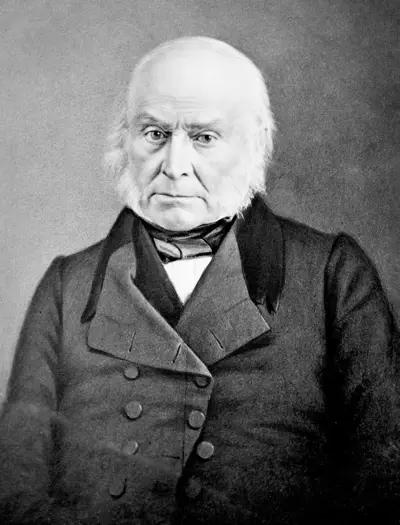
John Quincy Adams was an American statesman, diplomat, lawyer, and diarist who served as the sixth president of the United States, from 1825 to 1829. He previously served as the eighth United States Secretary of State from 1817 to 1825. During his long diplomatic and political career, Adams also served as an ambassador, and as a member of the United States Senate and House of Representatives representing Massachusetts. He was the eldest son of John Adams, who served as the second U.S. president from 1797 to 1801, and First Lady Abigail Adams. Initially a Federalist like his father, he won election to the presidency as a member of the Democratic-Republican Party, and in the mid-1830s became affiliated with the Whig Party.
