James Bryce Quotes
Why Great Men Are Not Chosen President
James Bryce, 1838-1922, British Ambassador to the United States, Chapter Title of The American Commonwealth, 1888
Sourced by: Eigen's Political and Historical Quotations


On that date, a few days before the election the FBI Director publicly announced that he was reopening the Investigation into possible wrongdoing of Ms. Clinon's use of provate emails. He had earlier cleared her of all criminal wrongdoing and and he claimed that they had found a new computer that had some e-mails that they had not not yet examined for possible criminal activity. In addition WikiLeaks published on the Internet thousands of private e-mails that the Russians had hacked from her campaign chairman and her comittee. The two things started moving her trend down so that she only one the popular vote by almsot 3 million votes and she needed more to overcome the electoral collage gave to rural and small states. Ironically, the FBI went throught the contents of the computer and after the election announced that there was nothing there that incriminated Ms. Clinton, and there was no criminal activity found in all the hacked e-mails. And the FBI Director was chastized by the Republican Justice Department after Donald Trump took office for improperly making pubic investigation details before there were any findings. The FBI Director was subsequently fired but this and otehr reasons were given as the reason.


This quotation illustrates the "winner take all" conceopt of many political cultures that call themselves and think of theselves as a democracy. But a true democracy does not allow a tyranny of the majority--especially a very narrow minority.


Ideologues and men of strong principles are not open to compromise and often are not persuasive of others. Compromise and persuasion is necessary for success in politics.

Harriman was the senior Democratic leader of the era. Every aspiring Democratic politician would make it his business to get to meet Harriman and try and get his endorsement. However, Carter was not a typical politician and when he decided to run for the Presidency, he had not even met many of the leading Democratic Party leaders. Harriman, a man of the old school, could not believe that anyone in the party who he did not know could possibly have the connections and the sophistication to win the presidency. However, Watergate had seared the American political soul and voters were not looking for a veteran, sophisticated politician. Nixon had been that.

This was a new political phenomenon where a President was perceived as more important, more powerful, and preferable to his party. Note that the base of the scale is labeled “Public Opinion”.


The three richest men in America—John D, Rockefeller, Andrew Carnegie, and Morgan, usually major rivals—had gathered together to decide what to do about William Jennings Bryan, who they viewed as very hostile to business and capitalism. (See {641037} and {641038} for Bryan quotation examples that concerned them.) They agreed to combine their efforts and back William McKinley who was running for the Republican Presidential nomination. In those days, the nominee was chosen by a small group of party leaders and their resources guaranteed McKinley the post. They then put large amounts of money to campaigning against Bryan and for McKinley including dirty tricks, many of which are illegal today. It is not known for certain whether McKinley knew the extent of the involvement of the monopolists, but shortly after assuming the Presidency he cut back on many of the relatively few regulations that then existed to control unbridled capitalism. Their effort went for naught when McKinley was assassinated and Theodore Roosevelt became President. Roosevelt would not be bribed or intimidated, and he did more to control monopolies than even Bryan would likely have.


Although a right wing conservative, he shared the view of many liberals that it costs so much money and needs so many rich contacts to raise enough money to run for President, that the reality is beyond the reach of ordinary Americans. Since Harry Truman, all the Presidents have been affluent, and most millionaires.

Critics were divided as to whether this illustrated that Graham was very naïve or very hypocritical. Graham had given Nixon a platform but he attended many Nixon events and was thought of as close to the President. When Watergate finally broke out in the open, Graham, had a major realignment of his view of politicians and has never gotten as close to any politician or appeared to favor a politician since.


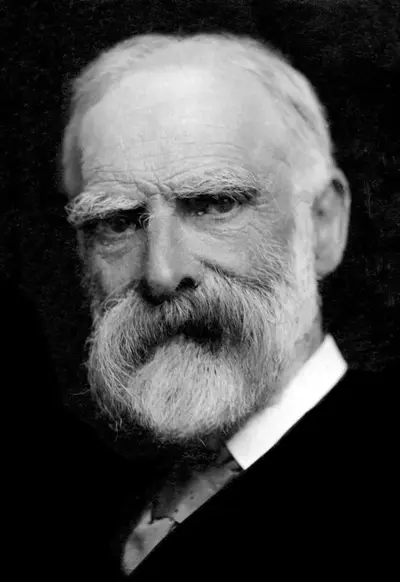
James Bryce, 1st Viscount Bryce, OM, GCVO, PC, FRS, FBA was an Ulster-born academic, jurist, historian, and Liberal politician.
