Pontius Pilate Quotes
Whether will the twain will ye that I release unto you?

In 1986 many scientists opposed the wisdom and feasibility of the administration's Strategic Arms Initiative. The director suggested that scientists who opposed government policies not be given government research grants. There was much protest about this seeming infringement of freedom of speech:
Wickes was asked if workers did not have a right to form a union. Earlier, many industrialists took the position that there was not even a right to form a union. This evolved to the more politically palatable position stated by Wickes. The result was the same however—no unions because very few—perhaps no—company would recognize a union if it was not required by law, and this is the way the law evolved—to require a company to recognize a union if it is voted upon by a majority of the workers.


Whithead’s view which seems intuitively right to most citizens, tends to be the one that the majority espouses but the minority opposes. At the time, the Republicans controlled the White House and there were a number of polarizing issues, where the Republicans could not obtain consensus and then decided. However, then the Democrats gained control of the White House and Congress the next year, it was the Democrats who claimed that they had to decide. The Republicans, now in the majority, argued that significant changes in America should not be made by narrow majorities and major issues should be tabled if there was no substantial majority. That was the position that the Democrats had espoused when they were in the minority.
This was well before Emancipation was adopted by President Lincoln. Blair a Virginian who was in favor of freeing all slaves and relocating them back in Africa and advised Lincoln of such. He was the first Virginian to actually free his slaves. See {594983} .


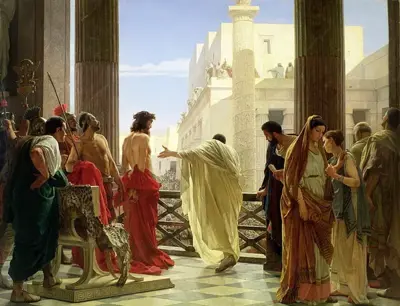
Pontius Pilate (Latin: Pontius Pilatus [ˈpɔntɪ.ʊs piːˈlaːtʊs]; Greek: Πόντιος Πιλάτος, Póntios Pilátos) was the fifth governor of the Roman province of Judaea, serving under Emperor Tiberius from the year 26/27 to 36/37 AD. He is best known today for being the official who presided over the trial of Jesus and later ordered his crucifixion. Pilate's importance in modern Christianity is underscored by his prominent place in both the Apostles' and Nicene Creeds. Due to the Gospels' portrayal of Pilate as reluctant to execute Jesus, the Ethiopian Church believes that Pilate became a Christian and venerates him as a martyr and saint.
