Millard Fillmore Quotes
Where is the true-hearted American whose cheek does not tingle with shame to see our highest and most courted foreign missions filled by men of foreign birth to the exclusion of the native-born?
The United States has often staffed its foreign mission with foreigners to save money or obtain specific skills.
Millard Fillmore, 1800-1874, 13th President of the United States (Whig, NY), Presidential campaign speech in his, unsuccessful campaign as a "Know Nothing", 1856
Sourced by: Eigen's Political and Historical Quotations

In a famous debate with Congressman Henry De La Flood (Democrat, VA), the issue was the common practice of hiring foreign nationals to represent the United States in many foreign posts, since their services could be obtained much less expensively than the costs of sending Americans abroad:. See President Millard Fillmore's 1856 campaign speech.


The Southern authorities were particularly angry with people form the North coming South to demonstrate over unconstitutional and immoral segregation laws. Northerners were considered as having no business with Southern desegregation. Mrs. Peabody, and the wives of a number of wives of Christian Bishops, black and white, went to a restaurant in St. Augustine and requested service which was contrary to the segregation laws of Florida at the time. The women were arrested. The act of civil disobedience in integrating the restaurant was one act of a planned desegregation strategy worked out with Martin Luther King’s SCLC organization. The mature age of the women and their prominent husbands brought a great deal of newspaper coverage which is just what the demonstrators wanted. The photo is of Mrs. Peabody getting arrested. See {637404} and {637406} for more on this incident.


The United States and some other nations had laws that specifically discriminated against Japanese in immigration and other aspects of society.


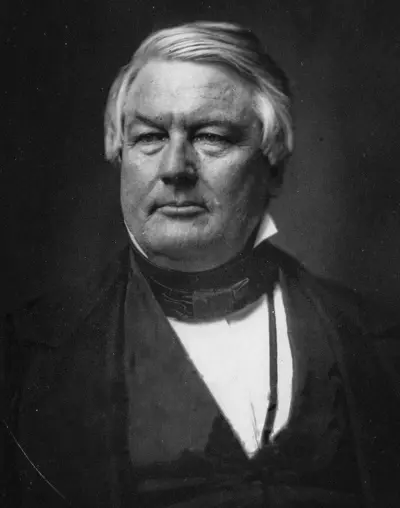
Millard Fillmore was the 13th president of the United States, serving from 1850 to 1853, the last to be a member of the Whig Party while in the White House. A former member of the U.S. House of Representatives from Upstate New York, Fillmore was elected as the 12th U.S. Vice President in 1848, and succeeded to the presidency in July 1850 upon the death of U.S. President Zachary Taylor. Fillmore was instrumental in the passing of the Compromise of 1850, a bargain that led to a brief truce in the battle over the expansion of slavery. He failed to win the Whig nomination for president in 1852 but gained the endorsement of the nativist Know Nothing Party four years later and finished third in the 1856 presidential election.
