New York Times Quotes
The United States has never had a neat, painless way to add newcomers. But our most shameful moments have involved the exclusion of groups, often those that do our hardest labor: Indians, African-Americans, Chinese, Irish, Italians, Catholics, Jews, Poles, Japanese-Americans, Hispanics. America has stood proudest when it dared to stretch the definition of who “we” are.
New York Times, Editorial, August 5, 2010
Sourced by: Eigen's Political and Historical Quotations


The Nixon "Southern Strategy" was that if the Republican Party made extensive efforts to appeal to minorities, given the previous decades of support of white supremacy, they would only be successful with a few, whereas if the Party went in the other direction and supported the Whites fighting against the Democratic initiated, racist hated, Civil Rights Act, they would get almost all the racist Southern Democrats, which were most white males and many white females. This racist policy enabled the Republicans to gain control of the Federal Government more often than not whereas before, it was very unusual.

Andrew Macdonald


What was absurd about this statement is that tens of thousands of men were drafted during the Vietnam war unless they had connections or were not physically fit. The implication that minority youth who did volunteer were not “patriotic” like he was became an insult to many Americans. The Congressman was a “Chicken Hawk”—a politician very aggressive about sending our military into combat, yet who never served in the military themselves. Later, DeLay was convicted and sentenced to jail for money laundering and illegally spending and raising campaign funds. He was also reprimanded by the House Ethics Committee for unethical methods of fund raising for other earlier actions.

At that time a number of state legislatures all changed their state voting laws to require citizens who try to register to vote to have documentation of various kinds and or obtain special documentation. These were generally possessed by upper class and educated people but not in as large proportions by lower and working class people. To obtain the documents and register if things like original birth certificates were not possessed, the citizen had to lose much of a day’s work and travel some distance. The burden existed on most lower class people and especially the minorities. The courts nullified some of these discriminatory requirements for voter registration, but many were allowed. The rationale was to prevent voter fraud and yet there were almost no cases of voter fraud in the entire country. While the requirements were racially discriminatory, they were also socioeconomically discriminatory. By coincidence, or perhaps not, every state that added these requirements had a Republican controlled state legislature AND a Republican Governor. Despite the effort to suppress Obama and Democratic voters, the effort backfired. Minorities and especially Blacks were so outraged that Jim Crow voting suppression had returned that they made a huge effort to register and get out the vote and Blacks voted in a much larger proportion than historical and well over 90 percent voted for Obama who won the election handily.

Lame was not opposed to civil rights as some who read this quotation sometimes conclude. He did think that much of the lack of success of minorities in America could be ameliorated by many self-improvement and individual efforts. His reference to destroying America, was an interesting rhetorical technique of assuming that what you advocate is not implemented and showing that it leads to disaster. Phrased this way, it gets and focuses the attention of an audience.


One reason that this is such a noteworthy quote is that Rubio was in the midst of his campaign for the Republican Presidential Nomination where only the most dedicated and generally conservative members of the party turn out to vote in the primaries. And a very large part of them were Southern racists who switched parties in response to the Civil Rights Act passage in 1964. Since then the very conservative wing of the party has had a de facto veto on Republican presidential candidates. Rubio's statement was the view of the majority of Americans and a significant number of Republicans, but this courageous statement of his true belief's risked his chances in the primary.
African Americans have developed their own unique culture, customs and even language which has been shaped In large part by slavery and living under Jim Crow. Foreign Blacks find that culture very foreign, having never experienced it. They were shaped by colonialism and and are familiar with white, Western, Christian culture. In addition a large proportion of African and Caribbean immigrant have been highly educated, professional trained, and or middle class. Also, the media stereotyping of American Blacks not only biases whites, but aslo biases foreigners of all ethnicities. So Black immigratnts frequently perceive American Blacks to be lower class, prone to crime and violence, uneducated and different from the and certainly from their aspirations." African Americans have developed their own unique culture, customs and even language which has been shaped in large part by slavery and living under Jim Crow. Foreign Blacks find that culture very foreign, having never experienced it. They were shaped by colonialism and and are familiar with white, Western, Christian culture. In addition a large proportion of African and Caribbean immigrant have been highly educated, professional trained, and or middle class. Also, the media stereotyping of American Blacks not only biases whites, but aslo biases foreigners of all ethnicities. So Black immigratnts frequently perceive American Blacks to be lower class, prone to crime and violence, uneducated and different from them and certainly from their aspirations.

I was born here. My children were born here. What the hell do I have to do to be called an American?
A Boston newspaper referred to Kennedy as "an Irishman." Until the latter part of the 20th century, there was an ugly, anti-Irish dimension to the national scene that was every bit as ugly as the other ethnic hatreds like anti-Semitism. The Irish like the early Jews had six strikes against them. They were foreigners. They were not Christian Protestants, they were poor, they did not know the American culture, they spoke English with a distinct accent, and they were the lowest of the lower classes. Even rich Irish like Kennedy were looked down upon and when his son ran for President he had to overcome a still significant block of anti-Irish Americans.
Before the French Revolution, Jews could freely practice their own religion in France but they could not hold citizenship, become professionals, or a host of other privileges of citizenship. Clermont-Tonnerre and other liberals argued that Jews should be given citizenship. The Jacobins--conservative Catholics close to the Papacy--opposed granting citizenship to Jews or Protestants. One argument that the Jacobins gave was that each of these sects would be separate nations within France and not necessarily have French national interest as a priority. Clermont-Tonnerre gave this response which has been the French philosophy about minority citizenship since then. Their thought was that anyone may become a French citizen as an individual but he or she should do so because he/she wants to accept French values and support the French nation. This view worked quite will over the years until the large immigration of Muslims starting in the 1960s where many new immigrants just wanted to live in France and earn a living there, but did not want to identify with French national aspirations or adopt French culture or values. America, had no such demands and those immigrants who tended to identify primarily with their country or culture of origin and not assimilate were allowed to do so, but the American way of life was so attractive that many immigrants did adopt it and even if they did not, their children almost inevitably did. That has not happened in France.
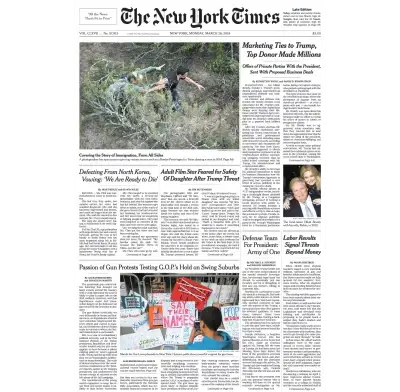
The New York Times (NYT or NY Times) is an American daily newspaper based in New York City with a worldwide readership. Founded in 1851, the Times has since won 130 Pulitzer Prizes (the most of any newspaper), and has long been regarded within the industry as a national "newspaper of record". It is ranked 18th in the world by circulation and 3rd in the U.S.
