W. Allen Wallis Quotes
When you pay social security taxes, you are in no way making provision for your own retirement. You are paying the pensions of those who are already retired. Once you understand this, you see that whether you will get the benefits you are counting on when you retire depends on whether Congress will levy enough taxes, borrow enough, or print enough money...
W. Allen Wallis, 1912-1998, Free-market economist, President, University of Rochester, Chairman of the Advisory Council on Social Security, May 27, 1976
Sourced by: Eigen's Political and Historical Quotations

This is one of the rare occasions where the person appointed to lead a major governmental program, publicy trashed the program and told citizens that they would never receive the benefits that they had already paid for. She was a partisan political appointment who had no real credentials, preparation or previous experience and her statement was so overtly political that few took the statement seriously although there were well known problems that Congress could fix as soon as they have the political will to do so. In the 15 years since this statement not a single worker has failed to obtain any benefits to which he/she was entitled. To see why such a statement can never be made with any certainty, see {619986} which explains the essence of Social Security.

Privatizing Social Security was the main piece of proposed legislation of George W. Bush’s second term. It was a conservative mantra for several years. It was finally defeated by a grass roots campaign of what Bush and his supporters referred to as scare tactics—projecting what might happen if the plan were implemented and the stock market went down substantially. With the Meltdown of 2008, the market crashed and this is what Galbraith is referring to. It would have been much worse than any of the privatization opponents had suggestion that even the staunchest economic conservatives would no longer advocate for privatizing Social Security. It was never even suggested in the Republican-controlled House of Representatives of 2012-2013.


18 years later, his son—George W. Bush—made the “nutty idea” one of the main planks in his Presidential legislative program. After the younger Bush traveled the country selling his reform ideas, the public came down on the side of his father and rejected the President’s “nutty idea.”

Commenting on the surplus in the fund:


The Supreme Court which had found many of the New Deal laws unconstitutional, saw no Constitutional Problem with Social Security. However, the most popular legislation in American history had many right wing and in this case Fascist opponents. The Sentinels of the Republic was a group of wealthy right wing extremists who opposed FDR and all his programs of which Social Security was the most important. See {620798}.

It was not known whether he actually believes such an extreme statement, or he just made it to pander to the extreme right wing of the Republican Party who were a large part of his political base. In effect he was calling the Great Republican Presidents after WWII like Eisenhower a con artist. See {622864}. A Ponzi Scheme is an illegal investment scheme designed so that the early investors get paid by the later investors and the crook running it skims money off the top and has no intention whatso ever to pay off the later investors. It is named after a Bostom Crook who ran the scam in the early 20th century.

Social Security was part of FDR’s New Deal legislation. It was passed in the middle of the Great Depression in 1936. By the end of the 20th century many people had forgotten or never learned that Social Security was a government social program. It provided relieve for two of the biggest social problems—old age retirement and disability. Most people have no idea that they had disability insurance covered by Social Security throughout their working lives unless they happened to be disabled. The price of a comparable private disability plan would be substantial, yet it is a benefit that most people have and few know it.


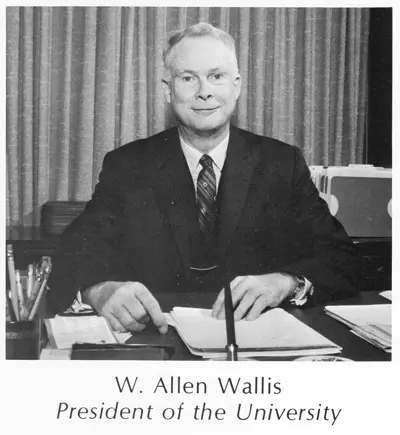
- Born: November 5, 1912
- Died: October 12, 1998
- Nationality:
- Profession: Administrator
Wilson Allen Wallis was an American economist and statistician who served as president of the University of Rochester. He is best known for the Kruskal–Wallis one-way analysis of variance, which is named after him and William Kruskal.
