Janet Flanner Quotes
When you look at the startling ruins of Nuremberg, you are looking at a result of the war. When you look at the prisoners on view in the courthouse, you are looking at 22 of the causes.
Flanner, Janet. "Letter from Nuremberg." The New Yorker, 23 Mar. 1946.

Adolf Eichmann was a German Nazi war criminal who had been responsible for the murder of millions of people. At the end of WWII, he had escaped Germany and was living in South America. Israeli agents found him, kidnapped him, and brought him to Israel. There he received a very public trial, was found guilt, and executed. In the War on Terror at the beginning of the 21st century, the key terrorists that were captured in Afghanistan were sent to a special prison base in the American part of Cuba. They were held there but at first received no trials or hearings. They were not prisoners of war, and not criminals where there were legal procedures for handling them. This was a new area. Some argued that they should all get trials. The Supreme court ruled that they at least had to get hearings. The correct handling was a major debate.


The general was replacing George S. Patton as commander of the Third Army. Patton had opposed the deNazification policy of the allies and caused a great deal of public relations difficulty for the army command and the administration, as reporters would frequently print his views. Truscott was one of Patton’s loyal assistants. The minute he took over, the press wanted to find out if his views were the same as his former boss regarding the Nazis. They were quite different. Reporters had no story.

The Germans killed 22 million Russians, most deliberate murders and not collateral damage, in WWII.


Allied calls for indictment of Emperor Hirohito. war crimes trials of Tojo and other Japanese leaders Senior officer responsible for investigating Japanese WWII war criminals. Fellers was the officer who had previously done the “research and investigation for his boss General Douglas MacArthur who had recommended no prosecution for the Emperor. See {605727}. Yonai was to get word to General Tojo and Admiral Shimada, already indicted as war criminals to minimize the role of the Emperor who had personally approved of Pearl Harbor and every major subsequent act of Japanese aggression. Shimada was “on board” but there were doubts about whether Tojo would go along with the deceptive exoneration of the Emperor.


The British and American bombing of Germany had become so effective that most of the German industrial system was destroyed. However, early in the War, Germany had violated the Geneva Convention and was indiscriminately bombing London and other part of England. In addition the German Air Force had bombed Warsaw, and many other cities throughout Europe. The German’s had killed over 20 million Europeans. When the Allied bombing produced high collateral damage against civilians, some argued that even though German had deliberately used this tactic, the allies should stop the saturated bombing if there were to be high civilian collateral damage. Others argued that it was unfortunate but a military necessity. There were others like Brenen, who argued that killing German women and children was desirable and just.
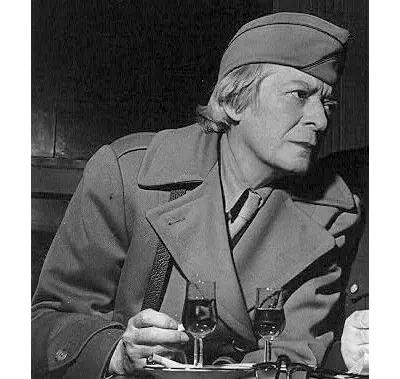
Janet Flanner was an American writer and journalist who served as the Paris correspondent of The New Yorker magazine from 1925 until she retired in 1975. She wrote under the pen name "Genêt". She also published a single novel, The Cubical City, set in New York City.
