Gilbert K. Chesterton Quotes
When people talk as if the Crusades were nothing more than an aggressive raid against Islam, they seem to forget in the strangest way that Islam itself was only an aggressive raid against the old and ordered civilization in these parts. I do not say it in mere hostility to the religion of Mahomet; I am fully conscious of many values and virtues in it; but certainly it was Islam that was the invasion and Christendom that was the thing invaded.
Chesterton, G.K. The New Jerusalem. Hodder & Stoughton, 1920.

Christians of 1 thousand years ago were barbarous and immoral compared to Christians of today, even though their Bible is the same. He argued that Islam may well also reform. In looking at Islam compared with Judaism, Christianity, Hinduism and Buddhism, it is useful to remember that these are much older religions than Islam. They have had more time to reform and develop. Compare Christians 700 years ago to Christians today. They were pretty barbaric in comparison. They burned heretics at the stake and "witches" also. But Islam is 700 years younger than Christianity and thousands of years younger than the other 3 religions mentioned. It may well need more time to develop and reform.


Different Christian European powers moved in and out of alliances with each other and with the Islamic Ottoman Empire. So Christians were not unified and whenever a Christian country was at war with the Muslims some Christians perceived it as an assault on Christianity—except that there were Christian allies of the Muslims. Later many Muslims would see any conflict with a Christian country as an attack in Islam even when Muslim nations were allied with the Christians as was Turkey at the end of the 20th century. Turkey was a member of NATO and was therefore seen as traitors to Islam by some Muslims. There has always been this tendency to see conflict in terms of religious or ethnic hostility where convenient.

In addition to the Muslim world during the Crusades losing control of the Holy City for the first time in 400 years, the Christians stabled their horses on the Al Axa Mosque and the Dome of the Rock, two of Islam’s holiest places. In addition, the Crusaders, after taking the city, slaughtered most of the inhabitants—Muslims, Jews and even fellow Christians who were Eastern Orthodox—more than 30,000 in just a day or so. It was a reign of terror on a scale that even today, it is shocking to most. So where as to us the Crusades were an interesting of aberrant part of history, to many Muslims of the Middle East the thought or discussion of the Crusades is traumatic even today.
When the Turks defeated the Christians, the only explanation many Christians could conceive of was that God was on the side of the Turks.
At the time of the writing she was an ex-queen. See {618099} for Frederick’s own view of the Greeks. The Crusades were going badly for the Christians at this point. The Greek Emperor had, after promising to be a part of the Christian alliance, made a separate treaty with Saladin and the Muslims, making him an outcast and sewing the seeds of the schism between the Eastern and Western Christian Churches. In a year, the Western Christians would sack Constantinople, and murder and plunder their fellow Eastern Christians. The two previous Greek Emperors were suspect from the Western point of view, but the treaty with Saladin “proved” what had been suspected about the Greeks who were now allied with the hated Muslims.

One remarkable aspect of this quote is that most Western nations have the exact same perception he claims the Islamic word does of what the West is doing. While the Western nations think the defense is necessary and desirable, the Muslim nations fundamentally believe that Christianity and Judaism should and will be supplanted by Islam. To the Islamic fundamentalist religion is a zero sum game. Every person in the world who is not a Muslim is an attack on Islam in that God wants all to follow Islam and wants the faithful to make it so.

He was the scientist most responsible for the Pakistani nuclear bomb capability. However, he took his technological knowledge and without the knowledge of his government and contrary to their promises to the United States and other nations, accepted large secret payments to assist third world dictatorships to begin a nuclear weapons program. When he was caught, he was arrested but he is one of the very few world class scientists that Pakistan had ever had and was one of the most famous and popular Pakistani figures. The Pakistani Supreme court ruled that he was free to move about Pakistan but may not leave the country, and he is supposedly monitored to prevent his sharing nuclear secrets with terrorists and dictatorial states. In 2012 he formed his own political party.


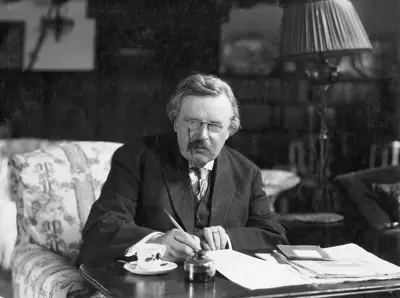
Gilbert Keith Chesterton KC*SG was an English writer, philosopher, lay theologian, and literary and art critic. He has been referred to as the "prince of paradox". Time magazine observed of his writing style: "Whenever possible Chesterton made his points with popular sayings, proverbs, allegories—first carefully turning them inside out."
