Charles Lyell Quotes
When on my return to England I showed the cast of the cranium to Professor Huxley, he remarked at once that it was the most ape-like skull he had ever beheld.
Lyell, Charles. The Geological Evidences of the Antiquity of Man. John Murray, 1863, p. 78.


Essentially, he was expressing a Darwinian idea in poetry. See Herbert Spencer {627582} for an even more specific argument for the same point.

This quotation is significant for several reasons. The 3 time candidate for President not only railed against anything having to do with evolution, but in this same year, participated as a prosecutor in the infamous Scopes Trial in Tennessee where a school teacher was convicted of a crime for discussing the idea of evolution in a high school classroom. In this case, he attacked anthropologist Henry Fairfield Osborn who had hypothesized that a fossilized tooth he had found might have come from a humanoid predecessor of Homo Sapiens. Bryan of course ignored the even then overwhelming evidence of evolution as a mechanism. He was actually right in criticizing Osborn in this case although Bryan had no real evidence for it. Two years later, Osborn published a retraction and correction indicating that better tools and methods of analysis indicated that the tooth was from a primitive species of pig and not of a pre human.


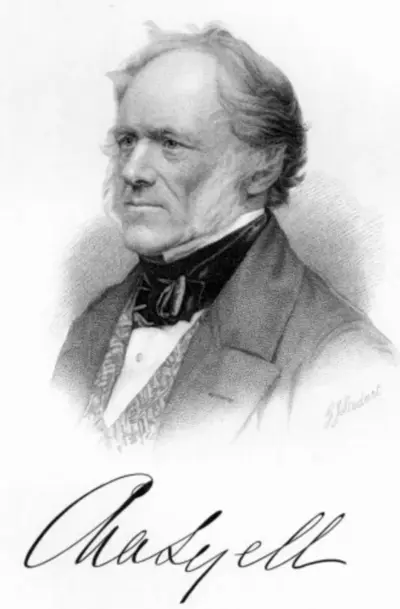
Sir Charles Lyell, 1st Baronet, FRS was a Scottish geologist who demonstrated the power of known natural causes in explaining Earth's history. He is best known as the author of Principles of Geology (1830–33), which presented to a wide public audience the idea that Earth was shaped by the same natural processes still in operation today, operating at similar intensities. The philosopher William Whewell termed this gradualistic view "uniformitarianism" and contrasted it with catastrophism, which had been championed by Georges Cuvier and was better accepted in Europe. The combination of evidence and eloquence in Principles convinced a wide range of readers of the significance of "deep time" for understanding the Earth and environment.
