Hugo Black Quotes
… when it is shown to us that a person is serving an illegal sentence our obligation is to direct that proper steps be taken to correct the wrong done, without regard to the character of a particular defendant or to the possible effect on others who might also want to challenge the legality of their sentences as they have the right to do 'at any time' under Rule 35. If it has any relevance at all, the fact that there may be other prisoners in this country's jails serving illegal sentences would seem to me to make it all the more imperative that we grant appropriate relief in this case rather than search for some obviously dubious excuse to deny this petitioner's claim..
Hugo Black, 1886-1971, U. S. Senator (Democrat, AL), U. S. Supreme Court Justice, Dissent, Green v. United States
Sourced by: Eigen's Political and Historical Quotations

Mistakes in the criminal justice system have been with us from the birth of the nation.

The Senator was referring to the large number of people who had been exonerated by DNA evidence while on Death Row.

The exonerated based on the investigative work of some volunteer attorneys and law students. None of the miscarriages of justice were found or discovered by any law enforcement personnel, prosecutors, judges or officials of Texas. All the exonerated were released from jail where many had served decades for crimes they did not commit. 5 were released from Death Row—awaiting to be executed. Perry’s logic was that there was no problem because the 56 were released. For him, innocent people serving decades in Jail and sometimes waiting to be executed, did not constitute a problem. Of course, he assumed that the 56 cases of exhortation were the only cases of wrongful convictions in Texas. See {635340}.

He was referring to exonerations for capital crimes like murder. He had written a book about a case where a man who was later proved innocent was reprieved only 5 days before his execution.

It is unfortunately too common that people have been convicted and jailed because of misconduct of the police or prosecutors. Most criminal justice agencies in recent years have examined their methods and procedures and reforms are in progress. But there is still a human problem. For an example see Quote


There were a number of anarchist organizations across the country and in New York that advocated anarchism. As Moss testified, one of the reasons that the anarchists found sympathizers and followers was the incompetence, corruption, and injustice of the courts. After the Page Commission report New York Courts began a reform and triggered similar court reform efforts throughout the country. Even today we have problems with overzealous or corrupt police or prosecutors who falsify or hide evidence, but the frequency is very small compared with what it was in the early 1900s.
Texas executes more people than the rest of the United States does. However, just before the debate an investigation disclosed 56 recent cases in Texas where the “criminals” were completely exonerated based on the work of some volunteer attorneys and law students. They were all released from jail where many had served decades for crimes they did not commit. 5 were released from Death Row—awaiting to be executed. See {635339}.

This quotation is a great example of the difficulty of deciding some of the major Constitutional issues. Most reasonable people believe that Rehnquist certainly has a point. On the other hand, critics observe that this quotation essentially says that it is OK to convict an innocent person if it cost too much or be too much trouble to do so. Reasonable people would also agree that this objection has much merit also. So the judicial system is stuck with deciding when the cost or trouble is too much. There will never, can never, be a clear cut answer.


“Celestial Marriage” is the term then used be Mormons to describe plural marriage.


Mormons were not only discriminated against but frequently robbed, murdered and ethnically cleansed from different parts of the country. In general the Federal Government did little or nothing regarding the plight of the Mormons.


This quotation has become an operational principle of most justice systems of industrial democracies.
Adopted by the original Edinburgh Review Magazine as its motto.

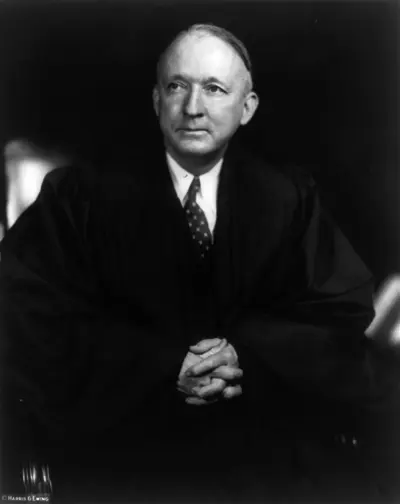
Hugo Lafayette Black was an American lawyer, politician, and jurist who served as a U.S. Senator from 1927 to 1937 and as an Associate Justice of the Supreme Court of the United States from 1937 to 1971. A member of the Democratic Party and a devoted New Dealer, Black endorsed Franklin D. Roosevelt in both the 1932 and 1936 presidential elections. Having gained a reputation in the Senate as a reformer, Black was nominated to the Supreme Court by President Roosevelt and confirmed by the Senate by a vote of 63 to 16 (six Democratic Senators and 10 Republican Senators voted against him). He was the first of nine Roosevelt appointees to the Court, and he outlasted all except for William O. Douglas.
