Frank Moss Quotes
I think there are more anarchists bred in those places (lower criminal courts of New York City) than are made in the meetings of the anarchistic clubs. I think that many a man who in his heart is innocent and who is brought up by the police unfairly before a court which handles him unfairly, whatever may be the reason, goes out with a feeling of hatred toward the institutions which we desire to sustain.
There were a number of anarchist organizations across the country and in New York that advocated anarchism. As Moss testified, one of the reasons that the anarchists found sympathizers and followers was the incompetence, corruption, and injustice of the courts. After the Page Commission report New York Courts began a reform and triggered similar court reform efforts throughout the country. Even today we have problems with overzealous or corrupt police or prosecutors who falsify or hide evidence, but the frequency is very small compared with what it was in the early 1900s.
Frank Moss, 1860-1920, Attorney, Prosecutor, & Reformer, New York City Police Commissioner (Succeeded Theodore Roosevelt), President of the Society for the Prevention of Crime, Testimony before the Page Investigatory Commission, ~1908
Sourced by: Eigen's Political and Historical Quotations


Mistakes in the criminal justice system have been with us from the birth of the nation.

Althought most of Seale’s “solutions” were counterproductive and/or ineffectual, and the Black Panthers were regarded as public enemies, Seale was right about some of his complaints including this one. In most of the South the changes forced by the Civil Rights and Voting Rights Acts where just beginning to have significant effect. So there were proportionately very few Blacks on Southern Juries. Even in the North, Blacks did not register to vote in proportion to their numbers so since jury pools were then usually drawn from voter registration lists, Blacks were statistically underrepresented. When a few Blacks were put on a jury panel, the prosecutor had the right of preemptory challenge as did the defense. But there were enough challenges so that the prosecutor could disqualify all the African Americans on the Jury. Even today, this is legal in many jurisdictions and although better than in 1970, then a Black defendant would rarely have African Americans on the jury of “his peers.”


It is unfortunately too common that people have been convicted and jailed because of misconduct of the police or prosecutors. Most criminal justice agencies in recent years have examined their methods and procedures and reforms are in progress. But there is still a human problem. For an example see Quote


See Jonathan Swift {35359} and William Shenstone {642165} for a later expression of this notion.


The Senator was referring to the large number of people who had been exonerated by DNA evidence while on Death Row.


The editor had discovered that she and her husband had had an affair before they were married and she was still married to another man. This would have ruined her husband’s political career and she decided to prevent that by killing the editor with the information. She was tried for murder and acquitted on the grounds that this was not a rationally premeditated murder but the uncontrollable emotional reaction of a woman who was so weak that she had no control over her actions. This was the excuse that the jury needed, as the personal slandering of politicians for things unrelated to their political activity was becoming very unpopular. This affair was the beginning of the tendency of the French media to not write about the personal and sexual activities of politicians which became a strong cultural tradition.

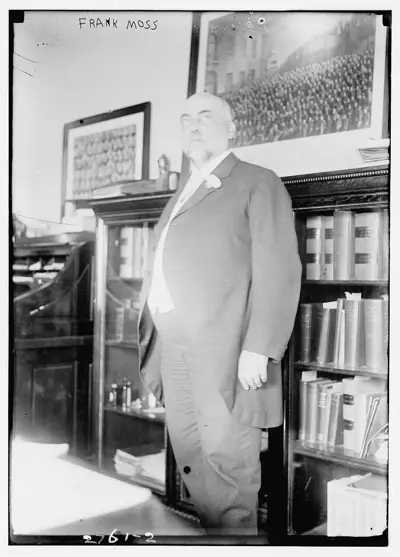
Frank Moss was an American lawyer, reformer and author. He was involved in many of the reform movements in New York City shortly before the start of the 20th century up until his death. As a longtime assistant to District Attorney Charles S. Whitman, he was involved in several high-profile criminal cases such as the Rosenthal murder trial in which police detective Charles Becker was found guilty of murder and executed.
