Everett Dirksen Quotes
When it comes to legislative inquiry there are no rules and actually the sky is the limit. I can ask a witness almost any question under the canopy of heaven and if one of my colleagues should intrude, I can say "you mind your own business and I'll mind mine.
Everett Dirksen, 1896-1969, U.S. Senate Minority Leader, (Republican, IL), Interview, ABC Television, June 1959
Sourced by: Eigen's Political and Historical Quotations

This practice is still followed.


President Abraham Lincoln had pocket vetoed his own party's reconstruction bill in the midst of an election year.


In a bitter debate on homosexual rights in the California Assembly, David Knowles, a freshman Republican spoke against the bill in extremely graphic and language.


Referring to Senator Joseph R. McCarthy:

There was much New England dissatisfaction with the disproportionate power held by the Southern states as a result of counting three-fifths of the slave population for apportioning Congressional seats. In addition they were disproportionately hurt by the War of 1812 and the Embargo on trade with England. Secession was proposed but failed to get a majority. A number of proposed Constitutional amendments were voted upon. The super-majority herein required would have diminished their vulnerability to Southern power.


This clause was a throwback to the days before the separation of powers where the legislature could imprison anyone they thought contemptuous or interfering with their deliberation. Contrast this with the earlier constitution of Massachusetts which forbade the legislature from acting as a judge or prosecutor. See {616750} and {616749}. Also this was a clear invasion of freedom of the press and freedom of speech provided by the Bill of Rights. However, at the time, it was not clear that the Federal Constitution was binding on State Governments on State Matters. Modern law is still ambiguous on this general point, but not on freedom of speech and the press which is currently definitely binding on the states.


In WWI Congress had passed a law that prohibited anyone from undermining or interfering with the war effort. The defendants had passed out anti-war literature to young men heading for military service. The court then overlooked the First Amendment and came up with a strange logic where the “clear and present danger” was the test of whether the First Amendment would apply. The anti war pamphleteers went to jail. Today, we look back on this and find it very surprising but this is yet another example of erosion of freedom and civil liberties when the nation is at war. By the 1950s, the Supreme Court had reversed itself and the First Amendment was restored to its original intent.


Sparta, an ancient Greek city-state, trained all its young men for war. One “test” was each youth was to sneak into the countryside and murder someone’s slave and not get caught. The murder was against the laws of the society, but if the young man was caught he was punished severely, not for murder or attempted murder, but for getting caught.
What was to become the 14th Amendment was being discussed. Several of the most radical Republicans drafted language that would allow Congress to make any law regarding life, liberty or property, so that they could be sure that the States would not make their laws in a discriminatory manner. However, Hotchkiss and the majority wanted to be sure the laws were not discriminatory but they didn’t want Congress to have the power to make any law regarding life, liberty and property for every state. The current version of the 14th Amendment just prohibited discrimination in laws, not empowering the Federal Government to override the state governments in most important areas.

He won the debate and the Congress created the first committee to investigate and oversee military affairs.

He lost the vote on this issue, and the Congress created the first committee to investigate and oversee military affairs.
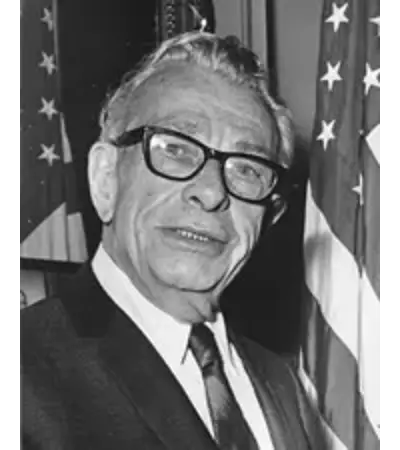
Everett McKinley Dirksen was an American politician. A member of the Republican Party, he represented Illinois in the United States House of Representatives and the United States Senate. As Senate Minority Leader from 1959 to 1969, he played a highly visible and key role in the politics of the 1960s. He helped write and pass the Civil Rights Act of 1964 and the Civil Rights Act of 1968, both landmark pieces of legislation during the civil rights movement. He was also one of the Senate's strongest supporters of the Vietnam War. A talented orator with a florid style and a notably rich baritone voice, his flamboyant speeches caused his detractors to refer to him as "The Wizard of Ooze".
