Charles de Gaulle Quotes
Whatever happens, the flame of the French resistance must not be extinguished and will not be extinguished. Tomorrow, as today, I will speak on Radio London.
de Gaulle, Charles. Discours et messages, 1940-1946. Plon, 1970, p. 3.


Explaining the reason for the Paris insurrection against the occupying Germans in World War II in contrast to the general French collaboration and capitulation. The French army, which was larger than the German, put up minor resistance and capitulated quickly when the Germans invaded. A number of French leaders formed a Nazi puppet government in Vichy. Many Frenchmen collaborated with the German Nazis. One of the main reasons for the formation of the French Resistance movement was for the French to have any honor after the war was over. They wanted the world to know that there were Frenchmen who valued freedom and justice and were not cowards--there were French who would risk their lives for freedom and justice. The French Resistance was extremely effective but very small, and to many Frenchman's embarrassment, the Communists were much more active in the Resistance than the conservatives. When the allies were closing in on Paris, and the German's were pulling out, the Parisians could just have waited until the Allied troops forced the Germans out. However, a small group of Parisians organized a major insurrection where Germans were attacked and sniped out while they were pulling out. When the Allies arrived, the Parisians had not been passive victims who had been freed by foreign troops, but had participated in their own fight for freedom and thus retained some honor and dignity. The insurrection was not without cost as many French men and women were killed in the insurrection, and many thought that the gesture of honor was an unnecessary risk and sacrifice. But the war ended in France with the French active in expelling the enemy with great bravery, something that had not generally happened at the beginning or in the midst of the war.


A few days before the Germans had bombed a few places around Paris. The French President and high officials after stating that they would defend the city against the Nazis ran out of town to the South. Then the city officials all ran including most of the police officers. All the foreign diplomats followed except for Ambassador Bullitt, a close personal friend of President Roosevelt. When he sent this cable, he and his staff had 2 revolvers and 40 bullets and asked FDR to send him some sub-machine guns to help him maintain order in the city. When the Germans arrived, there was not a single Frenchman who tried to stop them. The French Army had already run from the Battlefield outside of Paris. It is this dreadful, cowardly showing of the French which plagued De Gaulle and other French Patriots for years causing a great exaggeration of the extent of the French Resistance which was indeed heroic but only involved few Frenchmen and women. Fortunately, there was almost no looting of civil breakdown and the Germans arrived and took over. Bullitt never had to use his “armaments”.

Hoxha was a mixture of extreme Communist and extreme nationalist. Note the paranoia about intermarriage and interbreeding with other nationalities which was typical of Balkan nations,. He actually deluded himself into thinking that Albanian occupation and invasion had never resulted in female fraternization or rape and subsequent ethnic mixing. International communism however, on this point was just the opposite of Hoxha’s—the advocated an international view of intermarriage and breeding. Theirs was a class paranoia, not a nationalistic or racial paranoia.


“Removal” was interpreted by some as killing and by others as jailing. Complaining about wartime suffering or hardship was a crime in militaristic Japan.
After Japan attacked Pearl Harbor, we declared war on Japan. Germany then declared war on the United States, and America was in the fight. But the earlier policy had been to provide weapons, food, and supplies.
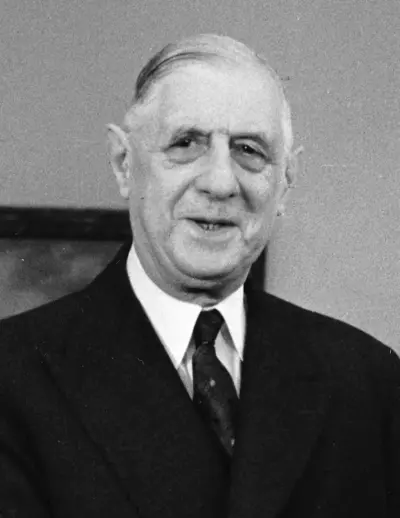
Charles André Joseph Marie de Gaulle was a French army officer and statesman who led Free France against Nazi Germany in World War II and chaired the Provisional Government of the French Republic from 1944 to 1946 in order to reestablish democracy in France. In 1958, he came out of retirement when appointed President of the Council of Ministers (Prime Minister) by President René Coty. He rewrote the Constitution of France and founded the Fifth Republic after approval by referendum. He was elected President of France later that year, a position to which he was reelected in 1965 and held until his resignation in 1969.
