William E. Dodd Quotes
What mistakes and blunders, and no democratic peoples do anything!
Dodd, in Berlin from 1933 to the onset of WWII, was able to see first hand what Hitler and the Nazi Movement was really like, Although he for the United States and Churchill for England warned early on, the politics of the times would not allow any action to stop or curtail Hitler. America, in particular, had a strong isolationist Republican wing and in addition, a small but loud core of pro Fascist, Hitler admirers such as Charles Lindberg, Father Coughlin, and Henry Ford. America had virtually no serious military capacity at the time, and with the Depression, FDR had all he could do to just gradually build up the military. By the time the Democracies realized that Dodd and Churchill were right, it was too late to prevent WWII. Dodd died in 1940 just when it was clear that he had been right.
William E. Dodd, 1869-1940), Historian & U. S. Ambassador to Germany (Democrat), Criticism of American and Allied Foreign Policy regarding Germany when Hitler and the Nazis came into power, Quoted in Erik Larson, In the Garden of Beasts
Sourced by: Eigen's Political and Historical Quotations


the Iraqi invasion of Kuwait


When the Japanese attacked Pearl Harbor later that year, Germany, fulfilling its treaty with Japan, declared war on America, and we were at war.


The Vietnam War is a good example. See {603755}.
Poincare and his policy advisors thought that the Germans were bluffing as they had in the past. This time they were not. WWI followed.


Dreadnoughts were huge battleships. Britain had the dominant navy of the world and controlled the seas. A European war would be a land war where a navy would be of little use. Hence, Britain would not want to get involved in such a war where she could not use her greatest military strength. He was wrong about this and so much else. Britain entered WWI when Germany invaded Belgium fulfilling her treaty obligations. The Germans intelligence operators and analysts were well aware of the treaty obligations, but had little understanding of English culture and tradition. The German aggression against a small power like Belgium was morally offensive to many in Great Britain, and Britain had a tradition of fighting for moral principles. The Germans would never militarily disadvantage themselves for the sake of a treaty obligation to a small nation, and they did not believe that the British would be so different and fulfill their treaty obligations even though their strongest military asset—their navy would not be very helpful.


Hopkins was a social worker with no military of political experience. But the President trusted him implicitly. Most American military officers and Ambassador to England Joseph P. Kennedy, a Nazi sympathizer & father of JFK, believed that England could not stand up to Hitler. Any military aid we gave England would fall into the hands of the Germans. Everyone was shocked when Roosevelt sent Hopkins to England to make a military recommendation. To impress Hopkins with something he thought Hopkins would be interested in, Churchill led a tour of workers cottages built by the government. Hopkins surprised Churchill and his aids who would never forget this statement & then asked to see the military facilities. Hopkins distressed the American military by recommending that Britain could hold out against invasion if they received military aid. Despite the contrary military advice, FDR accepted Hopkins’ recommendations, and the rest is history. He had been right and much of the military wrong.


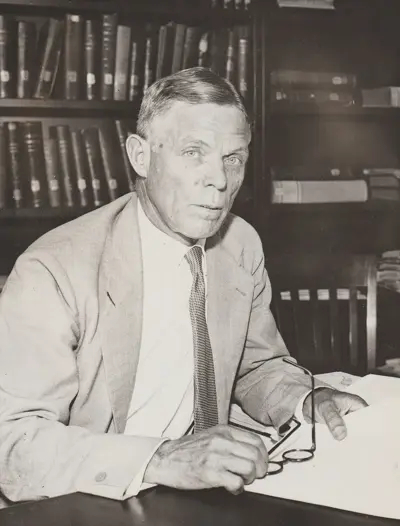
William Edward Dodd was an American historian, author and diplomat. A liberal Democrat, he served as the United States Ambassador to Germany from 1933 to 1937 during the Nazi era. Initially a holder of the slightly Antisemitic notions of his times, he went to Germany with instructions from President Franklin D. Roosevelt to do what he could to protest Nazi treatment of Jews in Germany "unofficially," while also attempting to follow official State Department instructions to maintain cordial official diplomatic relations. Convinced from first hand observation that the Nazis were an increasing threat, he resigned over his inability to mobilize the Roosevelt administration, particularly the State Department, to counter the Nazis prior to the start of World War II.
