Ron Paul Quotes
What have we allowed ourselves to become? Are we no longer a nation of laws? Have we become instead a nation of men who make secret arrests? Are secret prisons now simply another tool of the federal government law enforcement? Is secret rendition of individuals now permitted, out of misplaced fear? Have we decided that the writ of habeas corpus is not worth defending? Is torture now an acceptable tool for making us safe? Unfortunately, the single answer to all of these questions from the leaders of our country and to many of our citizens appears to be yes.
Ronald E. Paul, U.S. Congressman (Republican, TX), Libertarian Nominee for President, Speech, February 24, 2010
Sourced by: Eigen's Political and Historical Quotations


Rynnymede was the location in England where the Barons of the realm confronted King John and forced him to sign the Magna Carta. This was the first event that limited the powers of the King


Sunday Excise Laws, sometimes called “Blue Laws”, prohibited commercial activity on Sunday, the day most Christians believe to be the Sabbath. Then such laws had not been constitutionally tested and when the were later were they were all found to be unconstitutional. Some Christian sects believe that Saturday is the Sabbath as do most Jews. Muslims believe Friday is the Sabbath. So any state determination on the Sabbath favors some religious viewpoint and discriminates against others. Today, decisions about Sabbath are left to individual consumers and store owners.

Even in the United States, there have been occasions where this has happened such as the Japanese American internment in WWII, and the George W. Bush Administrations actions in fighting the War on Terror. Yew was in opposition at the time he made this famous statement. 30 years later when he was the Prime Minister, he had a different view. See {585201}.


During the 2006 War on Terror, the George W. Bush Administration established secret prisons in friendly countries where suspected terrorists could be housed and questioned without regard to the American laws and regulations—or even Presidential directives about torture. The prisons were on the soil and under the jurisdiction of foreign countries whose laws were not as respectful of human rights and the rule of law as ours. Therefore the administration could deny that the U. S. was responsible for what occurred even though we secretly transported the suspects to the secret prisons and American agents participated in their “interrogation.”


Responding to suggestions that drug traffickers be summarily executed:
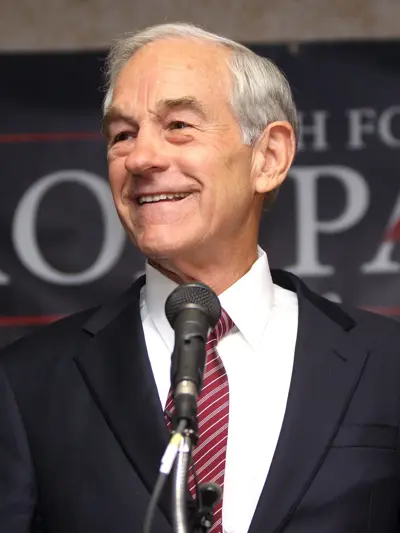
Ronald Ernest Paul is an American author, physician, and retired politician who served as the U.S. Representative for Texas's 22nd congressional district from 1976 to 1977 and again from 1979 to 1985, and for Texas's 14th congressional district from 1997 to 2013. On three occasions, he sought the presidency of the United States: as the Libertarian Party nominee in 1988 and as a candidate for the Republican Party in 2008 and 2012. A self-described constitutionalist, Paul is a critic of the federal government's fiscal policies, especially the existence of the Federal Reserve and the tax policy, as well as the military–industrial complex, the war on drugs, and the war on terror. He has also been a vocal critic of mass surveillance policies such as the USA PATRIOT Act and the NSA surveillance programs. He was the first chairman of the conservative PAC Citizens for a Sound Economy, a free-market group focused on limited government, and has been characterized as the "intellectual godfather" of the Tea Party movement, a fiscally conservative political movement that is largely against most matters of interventionism.
