Henry A. Kissinger Quotes
The illegal we do immediately. The unconstitutional takes a little longer.
Henry A. Kissinger, U.S. Secretary of State (Republican), U.S. National Security Advisor, Nobel Peace Laureate, Quoted in The Washington Post, December 23, 1973
Sourced by: Eigen's Political and Historical Quotations


TR had a Supreme Court where a conservative block was in the majority and declared a number of his key reforms as unconstitutional. The same thing happened to FDR as well. Since Supreme Court justices had lifetime tenure most presidents and congresses have to deal with a court that has the political makeup and political philosophy of previous administrations by which they were appointed. Reform and change presidents tend to see the Supreme Court as obstructionist.


Despite Ziglar’s and other officials pointing out the illegality, illegal sweeps and arrests were made without warrants or constitutional requirements.


President George W. Bush had ignored a federal law and tapped the phones of Americans without probable cause and a warrant issued by a court. The President’s defenders argued that the President, as Commander in Chief, has the Constitutional responsibility to lead the military and protect the nation. Intelligence gathering is part of military activity. Therefore the intelligence gathering is a Constitutional duty and the Congress, under the separation of powers doctrine, may not interfere with the President’s Constitutional Duty to conduct intelligence. Under this doctrine, the President need not obey laws that he believes impinge on his management of the war effort and the defense of the nation. Most legal scholars believe that this argument is nonsense, but the George W. Bush administration has stated the doctrine and it was the subject of much litigation.

One of the conundrums of our constitutional system is who has the last word as to what the Constitution means. Essentially it is the judicial branch headed by the Supreme Court. But there are those who believe that the current popular majority should have a say in what is or is not constitutional. If so the legislative branch should have the last word. Still others say that the President is the only person elected by ALL the people, so his opinion most reflects the will of the public. And then there are most who argue that the Constitutional system was created just to avoid the power of currently popular majorities, and the courts should decide based on the Constitution itself. So the statement has very little meaning except that Phillips thinks that the courts have too much power. Whoever gets to decide what is or is not Constitutional will be accused of being “over” the Constitution by those who don’t like the decisions. In our system, that is the courts.

In 2006, in the midst of the War on Terror, it was revealed that President George W. Bush had approved a electronic surveillance program that was on the surface contrary to the FISA laws prohibiting such government activity. The President claimed that the necessities of the war required such a deviation. A national debate ensued as to whether the President was always required to follow laws as passed or did he have “inherent powers” under the Constitution to do whatever he thought necessary to fight a war.


Powell was the Secretary of State and Addington kept advising the administration that as long as the President was acting in defense of the country in his capacity as Commander in Chief, he did not have to obey any existing laws that had been Constitutionally passed which in the opinion of the President restricted or limited the President or the executive branch. Addington was an attorney and Assistant to the Vice President, but he was given much responsibility for administration policy. Powell the Secretary of State of the Administration could not have disagreed more and although most politicians including Republicans disagreed with the Addington thesis, Powell was one of the few Republicans to criticize the Addington position.


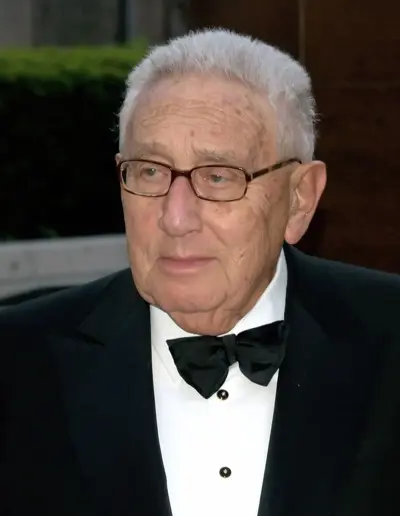
Henry Alfred Kissinger KCMG is an American politician, diplomat, and geopolitical consultant who served as United States Secretary of State and National Security Advisor under the presidential administrations of Richard Nixon and Gerald Ford. A Jewish refugee who fled Nazi Germany with his family in 1938, he became National Security Advisor in 1969 and U.S. Secretary of State in 1973. For his actions negotiating a ceasefire in Vietnam, Kissinger received the 1973 Nobel Peace Prize under controversial circumstances, with two members of the committee resigning in protest.
