W. E. B. Du Bois Quotes
What after all am I. Am I an American or am I a Negro? Can I be both? Or is it my duty to cease to be a Negro as soon as possible and be an American? If I strive as a Negro, am I not perpetuating the very cleft that threatens and separates black and white in America.
W. E. B. Du Bois, 1868-1963, Educator and author, Co-Founder of the NAACP, Quoted in David Levering Lewis, W. E. B. Du Bois: Biography of a Race
Sourced by: Eigen's Political and Historical Quotations


Bilbo was one of the worst racists who ever served in the Congress.

The court. despite Harlan’s dissent, found the Kentucky “Day Law”—making it illegal to have Nego and White Students in the same college even if the college is totally private.

Thus testimony was an example of one of the reasons that Black Americans lobbied to end the use of the word, Negro, in official documents to describe them. “Negro” was a term used by whites to describe Blacks but rarely used by Blacks until Reconstruction. A century later, cultural and official language went back to the language that the slaves had used to describe each other and added “African American” as well.


This painting depicted a young black girl walking to school surrounded by 4 U. S. Marshalls protecting her from the crowd of white racists trying to prevent her from attending an elementary school under court order. The vicious race hatred that school integration revealed was the national problem that was then surfacing. The graphic is the illustration that appeared in Look with that name.


Bilbo was one of the worst racists who ever served in the Congress.


Moynihan was actually not the political originator of the "benign neglect" phrase which became so controversial. It had been first used by The Earl of Durham in his 1839 Durham Report on the English policy towards Canada.
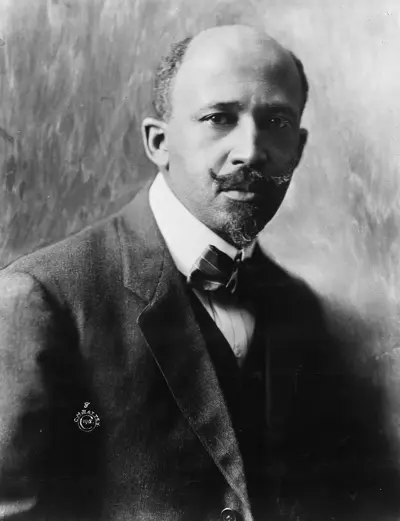
William Edward Burghardt Du Bois was an American sociologist, socialist, historian, and Pan-Africanist civil rights activist. Born in Great Barrington, Massachusetts, Du Bois grew up in a relatively tolerant and integrated community. After completing graduate work at the Friedrich Wilhelm University (in Berlin, Germany) and Harvard University, where he was the first African American to earn a doctorate, he became a professor of history, sociology, and economics at Atlanta University. Du Bois was one of the founders of the National Association for the Advancement of Colored People (NAACP) in 1909.
