J. William Fulbright Quotes
What a paradox if our own cleverness in science should force us to live underground with the moles.
J. William Fulbright, 1905-1995, U. S. Senator (Democrat, AR), Chairman, Senate Foreign Relations Committee, "The Effect of the Atomic Bomb on American Foreign Policy," Address, Foreign Policy Association, New York City, October 20, 1945
Sourced by: Eigen's Political and Historical Quotations


The Scientific Project that developed the Atomic Bomb. In the development of the atomic bomb there was a hypothetical possibility that the Earth as we know it might be destroyed. Robert Oppenheimer the scientist who directed the bomb development and his staff framed the question which Oppenheimer presented to Arthur Compton. The decision was that Oppenheimer’s team would calculate every possibility and make sure that such a catastrophe was not within the realm of possibility. They did all the calculations, concluded that there was no possibility, the bomb was exploded, and the question was then finally answered in the negative.

See {626813} for another quotation on this point.

Most environmentalists limit the vision of their solutions to using less of our precious natural resources which is very important but just as important and perhaps more so in the long run is increasing the supply of these resources. Food is an example. The major reason that there is no serious food shortage world-wide is that we have increased the productivity of agriculture requiring less labor, less water, less fertilizer, less land, and less dependency on weather. Distribution has also improved, but there is no very good way of distributing something for which there is a great shortage.


One fascinating thing about this quotation is the date. It would be the next 150 years where the great scientific leaps would take place. There was no inkling of computers or nuclear weapons.

Most scientists do not have the skill or the totality of knowledge to accurately predict the effect of scientific research and learning on society. Many are not interested. Those who try to communicate with politicians and the public are usually met with indifference or suspicion. Above all, the scientific and mathematical literacy of the public is so weak, that it is impossible in much of science to even explain the science to the lay public much less explain its implications. Soddy was a bit of an idealist from a class society and he felt the upper classes should be better informed by scientists.

Einstein saw the war as madness but what distressed him most was that his friend and colleague, Fritz Haber, to help the war effort developed poison chlorine gas as a weapon which killed and maimed hundreds of thousands. He was a devoted pacifist thereafter. It took an even greater madman like Adolf Hitler and his Nazis to reach the mental point where he recommended to President Roosevelt that scientists develop an atomic bomb.
Hansen whose research documented some of the effects of global warming was censored by the George W. Bush administration. The censors argued that the effects of global warming had not yet been completely studied and that many of the factors and effects were still unknown. Therefore, government officials should not speak out until all the data is in and has been analyzed. Ironically, the Bush administration took the country to a preemptive war arguing that it was imprudent and dangerous to wait until all the evidence was in and analyzed. It turned out that the Bush rationale for the war was not the case and there was poor intelligence or a subconscious or conscious attempt to deceive.


For a similar view from the eyes of an American, see Pearson {612242}.


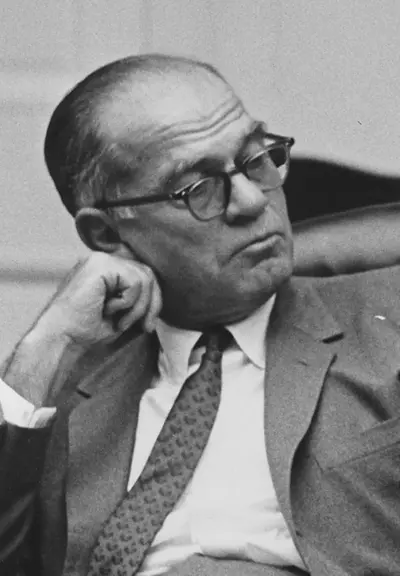
James William Fulbright was an American politician, academic, and statesman who represented Arkansas in the United States Senate from 1945 until his resignation in 1974. As of 2021, Fulbright is the longest serving chairman in the history of the United States Senate Committee on Foreign Relations. He is best known for his staunch multilateralist positions on international issues, opposition to American involvement in the Vietnam War, and the creation of the international fellowship program bearing his name, the Fulbright Program.
