Alan Greenspan Quotes
Were we to find ourselves in a world in which there was a very significant amount of dollarization, … it would be in the political interests of certain parties in other countries whose policies were less than perfect …, to blame us as the root of their problem.
Alan Greenspan, Chairman, Federal Reserve Board, Testimony, Senate Committee on Banking, Housing and Urban Affairs, April 1999
Sourced by: Eigen's Political and Historical Quotations


The “Fed Note” was the term for a Federal Reserve Note. It was a then a new form of paper money issued by the Federal Reserve Banks instead of the Treasury department as the previous United States Notes had been. The United States was a guarantor of the Federal Reserve Notes in case the Federal Reserve defaulted and there were many who feared having the responsibility to back up the Federal Reserve notes which could be issued by the Federal Reserve Banks—not government entities and not under the control of the President or Congress.


Perry was an extremist politician who commonly exaggerated things to the delight of his supporters and the chagrin of his opponents.

The same argument can be made against the modern paper money supply. What Jefferson and most of the founding fathers, with the exception of Alexander Hamilton. did not realize was that the major stability of any kind of money was not only the silver or gold that backed it but the political and legal stability of the nation and the size of its productive economy. Where Jefferson was right however is that all these banknotes at the time were issued by local private banks. The Government had no responsibility for paper money and had no knowledge of how much paper money any bank issues and whether or not they had any silver to back it up. Banks didn’t trust other bank’s notes and would only redeem them at a discount. A $10 note from a South Carolina bank might only be worth $7 in New York and $6 in Boston. The early American monetary system was a mess.

Much of the South during the Civil War lived in a fantasy universe where all the reality would not impinge upon them. Eggleston was an accomplished writer who had served in the Confederate army of the Civil War. 20 year after the war he wrote a series of articles for the prestigious Northern Atlantic Monthly trying to convey the war from the Southerner’s point of view. The South just kept printing money to take care of their perceived war and civilian needs without regard to the value of the money they were printing. Even in the 21st century collectors had a great deal of Confederate paper money, that had value only as a historical curiosity.

What the Prime Minister was trying to say is that the buying power had not been diminished suddenly for local and non-imported items.

Roosevelt saw to it that the contents of the telegram was shown to the press. Then this statement was seen by the foreign delegates who viewed themselves as ‘international bankers”. They were outraged and the conference blew up with no significant action taken. Roosevelt was desperately trying to lead America out of the Great Depression which Herbert Hoover had left him with. The dollar had been falling in value since the 1929 crash and one of the likely outcomes of the conference was European and other nations putting a plan together to stop the fall of the dollar. FDR however, wanted the dollar to continue to fall. This would make it harder for Americans by buy imported products, but easier to employ more Americans making products for export. The people hurt most by The Depression did not buy any imported products, and what they needed was food, housing, clothing, education and medical care, none of which would be affected by a weaker dollar and more expensive imports. However, he did not want a political argument with the wealthy and upper middle class who wanted cheaper imports, so some people believe that he made it seem that he had committed a diplomatic blunder and that caused the conference to collapse.

This is an excellent historical example of how damaging it can be for a country if its leaders do not understand the technicalities of economics and currency manipulation.

At that point in time the world price of oil, Russia’s major revenue source, had declined to half of what it was last year. Many American’s gloated. Freidman urged caution.


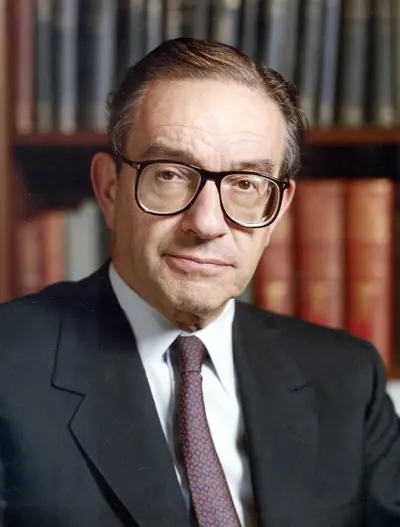
Alan Greenspan is an American economist who served five terms as the 13th Chair of the Federal Reserve of the United States from 1987 to 2006. He works as a private adviser and provides consulting for firms through his company, Greenspan Associates LLC. First appointed Federal Reserve chairman by President Ronald Reagan in August 1987, he was reappointed at successive four-year intervals until retiring on January 31, 2006, after the second-longest tenure in the position (behind William McChesney Martin).
