Sima Samar Quotes
We wish for a broad-based government with the active participation of women, which will promote freedom and equal rights for women
Samar, Sima. Interview. "A Nation Challenged: The Women; Feminist Among 2 Named to Afghan Cabinet." By Barry Bearak, The New York Times, The New York Times Company, 6 Dec. 2001, p. B2.


This quotation illustrates the statement of a reform principle to appease international interests in basic human rights. This type of statement provides the “fig leaf” for the UN and other organizations to pretend that international standards of human rights are being maintained. Nasser did not implement this principle. By the beginning of the 21st century, Egypt was finally making some progress on women’s equality issues. The prohibition on female members of Parliament—{586723}—had been reversed but women were still not allowed to be judges in a criminal trial, laws against infant female circumcision, and other elements of female equality were still not in existence.


Jinnah was a modern Islamist who saw the role of females in a modern context. He, like the Indian Hindu leaders were in a sense products of the West and Western government and education. He would be very surprised that in his Pakistan men can murder their female relatives who they believe have dishonored the family, or that women would not be educated in the Madrassas, or that authorities could sentence a female relative of a man deemed guilty of seduction to be gang raped, but that is what happens in modern Pakistan. Jinnah and many of the early leaders believed that their new government could modernize Islam but the control and influence went the other way. Pakistan became a religiously dominated autocracy rather than the democracy that Jinnah foresaw.


This remarkable statement was written in about 1840 and there was probably then few people of either gender who would think such a thing possible.


Prior to WWII there were few women in the labor force, and the traditional “values” of American society relegated women to be homemakers. However with so many men under arms, there were not enough workers to achieve the war production that was necessary. So changes had to be made in public attitudes, not only towards women working, but the nature of the work that they are capable of and ought to be doing. So the government took a proactive role in changing public attitudes towards women in the workforce. It was a successful effort, and the sociological and psychological effects are still felt, half a century later. See {584781}.
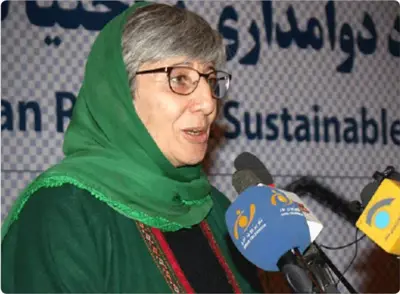
Sima Samar is an Afghan woman's and human rights advocate, activist and a social worker within national and international forums, who served as Minister of Women's Affairs of Afghanistan from December 2001 to 2003. She is currently the Chairperson of the Afghan Independent Human Rights Commission (AIHRC) and, from 2005 to 2009, United Nations Special Rapporteur on the situation of human rights in Sudan. In 2011, she was part of the newly founded Truth and Justice party. In 2012, she was awarded the Right Livelihood Award for "her longstanding and courageous dedication to human rights, especially the rights of women, in one of the most complex and dangerous regions in the world."
