Emmeline Pankhurst Quotes
You must make women count as much as men; you must have an equal standard of morals; and the only way to enforce that is through giving women political power so that you can get that equal moral standard registered in the laws of the country. It is the only way.
Pankhurst, Emmeline. "Freedom or Death." 13 Nov. 1913, Parsons' Theatre, Hartford, CT.


Jinnah was a modern Islamist who saw the role of females in a modern context. He, like the Indian Hindu leaders were in a sense products of the West and Western government and education. He would be very surprised that in his Pakistan men can murder their female relatives who they believe have dishonored the family, or that women would not be educated in the Madrassas, or that authorities could sentence a female relative of a man deemed guilty of seduction to be gang raped, but that is what happens in modern Pakistan. Jinnah and many of the early leaders believed that their new government could modernize Islam but the control and influence went the other way. Pakistan became a religiously dominated autocracy rather than the democracy that Jinnah foresaw.


See Belva Lockwood {609865} for the view of the woman who lobbied heavily for the law and became the first woman to practice before the Supreme Court.


Stowe persuaded Lockwood to stand for President. They tried to recruit a man for the Vice Presidential nomination, and when they could not, Stowe became the first female to become a Vice Presidential candidate.

Sister of Max Eastman. Women had just obtained the vote, but it was illegal to distribute information about birth control or birth control devices. It was not until 1963 that the Supreme Court nullified criminal statutes against distributing birth control devices.


This remarkable statement was written in about 1840 and there was probably then few people of either gender who would think such a thing possible.


This phase of American feminism was beginning but even he had no idea of how fast it would be propelled as a result of the Second World War which would begin at the end of that year.


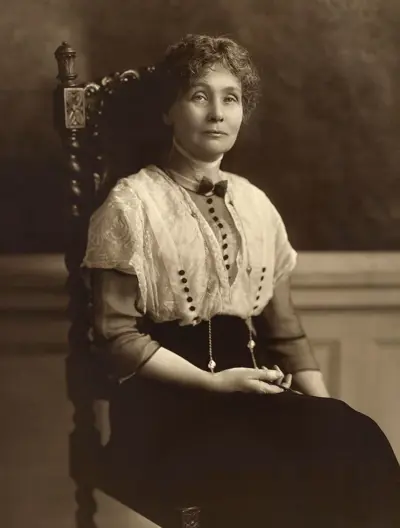
Emmeline Pankhurst was a British political activist. She is best remembered for organizing the UK suffragette movement and helping women win the right to vote. In 1999, Time named her as one of the 100 Most Important People of the 20th Century, stating that "she shaped an idea of objects for our time" and "shook society into a new pattern from which there could be no going back". She was widely criticised for her militant tactics, and historians disagree about their effectiveness, but her work is recognised as a crucial element in achieving women's suffrage in the United Kingdom.
