Frederick the Great Quotes
We will never cause any money to be coined in the land of any of the princes which shall be injurious to his coinage.
Frederick II, 1215-1250, German King & Holy Roman Emperor, Statute in Favor of the Princes, 1231
Sourced by: Eigen's Political and Historical Quotations


This objective finally reached its peak in the Nixon administration when the U. S. went off the gold standard. 75 Years after FDR tried to make the U. S. dollar more resilient, America had been so successful that many foreign governments having the same problem of little or no control over their currency, have pegged their currency to the U. S. dollar, thus gaining our stability.


See {583710} for his grandchild’s variation.

At the time, there was no United States currency. Private banks in some of the states issued their own money. A dollar from Georgia might only be worth 75 cents in New York.


This is the first major history of banks written in the United States.

At the time, a bank note—paper money issued be a private bank—was not backed by any gold or silver and was not insured bym the government. A bank could print as much as they wanted, so it was always worth less as the further you were from the particular issuing bank, the less you could get your bank note, because no one knew whether or not the issuing bank would redeem the note or even be in existence. So every private bank note had diminished value for the public. However, carrying gold and silver around and making change for precious metals was difficult and often impractical. So people used banknotes. The same thing happens with credit cards today. The merchant has to pay a fee to the credit card company and the bank and therefore charges us more for whatever we buy. But most consumers and merchants are willing to pay the difference to obtain the convenience of the credit card,

At the time any private bank could issue their own money. Private sector bankers thought it outrageous that the Congress should consider trampling on their rights to issue money. The solution that was finally adopted some years later was to use the Federal Reserve Board to control the money supply. It is independent of the Congress and the President but members are appointed by the President and confirmed by the Senate. Our system, like no other system, is a compromise where neither the Government or the Private Sector controls the American money supply.

This was a very astute prediction. At the time, the United States gold mining production was second only to South Africa and American currency was based on the gold standard which seemed to all to be permanent. Half a century later, the U. S went off the gold standard.

The alternative would have been for the colonies to borrow English money at high interest rates and use that. Or use money from private banks (which occurred later.) Many conservatives are today a little shocked that some of the American Colonies just printed money with no backing but it worked—at least at the local level. A Boston Bank for example, would take a large commission for a Bostonian to convert Pennsylvania money into Massachusetts money. So it was not a very good system for trade between colonies and International trade. But English money was used for that. The colonists pragmatically got the “best of both worlds” and paid as little interest as they needed to. This system is essentially what we use today on a national scale with no gold or silver backing of the money.


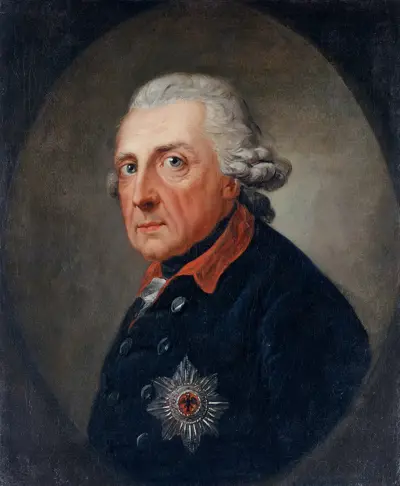
Frederick II was a Prussian king and military leader who ruled the Kingdom of Prussia from 1740 until 1786, reigning longer than any other Hohenzollern king. His most significant accomplishments during his reign included his reorganization of Prussian armies, his military successes in the Silesian wars and the Partitions of Poland, and his patronage of the arts and the Enlightenment. Frederick was the last Hohenzollern monarch titled King in Prussia and declared himself King of Prussia after annexing strategic parts of the Polish–Lithuanian Commonwealth in 1772. Prussia greatly increased its territories and became a leading military power in Europe under his rule. He became known as Frederick the Great (German: Friedrich der Große) and was nicknamed "The Old Fritz" (German: "Der Alte Fritz") by the Prussian people and eventually the rest of Germany.
