Robert Mugabe Quotes
We will have no mercy for white people regarding the land, they cannot own our soil.
Mugabe, Robert. Speech during a tour of Mashonaland West. 2 Jul. 2014.


Use included renting it. What he opposed was simply holding land when whites were driving Indians off their lands because all the unused land outside of the reservation was owned by someone and the asking price was very high. Ingersoll was considered to be the greatest orator and political thinker of his day, but his overt atheistic views curtailed his elected political career.


In every society where there had been past unjust ownership of land, all efforts of land reform were faced with the problem of having to dispossess the current “owners” who themselves had not been guilty of the crimes of their ancestors in unjustly obtaining the land originally. In America land reform was unworkable in most cases and the solution was usually a large monetary payment as compensation for the land.

Jackson refused to obey this decision, He was the only American President who disobeyed a Supreme Court Decision. In doing this, he killed tens of thousands of Indians, allowed the Southern Whites to steal most of the Cherokee land. His Indian Removal, contrary to this Supreme Court decision, was the worst case of ethnic cleansing in the history of the United States.

See {638095} for a brief explanation of the Jubilee. Spinoza was one of the most feared intellectuals in human history—feared that is by the established power structures. He is the only known person who was excommunicated by the Catholics, the Jews and the Muslims—all were forbidden to read his works. He was the enemy of authority and advocated personal reason as the guide for men.

This is an important quotations for two reasons. First, one of the white Europan myths in the colonial era was that the Native America had not concept of land ownership and title. This quotation clearly refutes that/ Second, this shows that some Europeans coming to the new world opposed the view that the white Christians and a moral right to the Native American “heathen” land. A few like Williams did not.
If the land to be redistributed is divided amongst the majority population, each parcel would be too small to make any difference in any recipient’s life. For efficient agriculture there must be large land holdings. The colonial, stolen land history is valid for most former colonies, however, in Southern Africa, the situation was more complicated. When the whites landed at Capetown in the South, they moved North “stealing” land as they went. However, in Central Africa, Shaka and his Zulus were also a colonial power, and they moved South “stealing” land from the indigenous Blacks as they went. Eventually, the two Colonial Powers—the whites and the Black Zulus—clashed and the Zulu Wars ensued. So all of the land in Zimbabwe and South Aftica was stolen from the Blacks—except about half was stolen by Blacks. After the Zulu Wars, the victorious whites ended up “stealing” land from the Black Zulus that had been stolen by them from other Blacks. Also although the English were the official colonial power, the Dutch “Afrikaners” were a powerful subculture which was dominant on many parts of South Africa and especially at the frontier and they did most of the land stealing. The ethnic English were the businessmen and the city dwellers who actually ruled that Blacks were citizens with rights and slowedmdown some of the land stealing. There is no more complicated ethnic history in the world.

See {638124} for how this Biblical passage evolved into a concept of property ownership

It is very hard, when we have let the King's subjects have so much of our lands for so little value.
He had received an English style education and had a much better idea of the market value of the land than most of the other Iroquois.


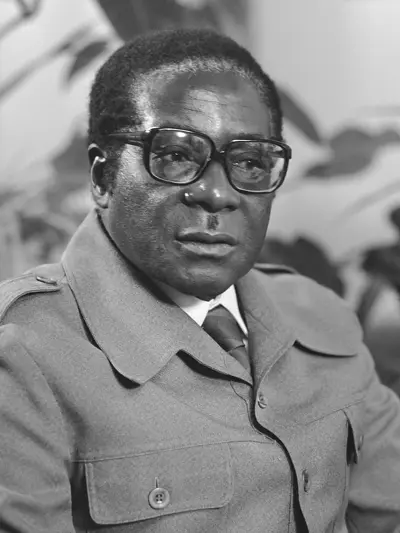
Robert Gabriel Mugabe was a Zimbabwean revolutionary and politician who served as Prime Minister of Zimbabwe from 1980 to 1987 and then as President from 1987 to 2017. He served as Leader of the Zimbabwe African National Union (ZANU) from 1975 to 1980 and led its successor political party, the ZANU – Patriotic Front (ZANU–PF), from 1980 to 2017. Ideologically an African nationalist, during the 1970s and 1980s he identified as a Marxist–Leninist, and as a socialist after the 1990s.
